
Understanding the Major Yoga Certifications Worldwide
Yoga Alliance RYS, Aayush Mantralaya YCB, and the World’s Top Yoga Certification Bodies — A Complete Guide for Aspiring Yoga Teachers
By the Faculty at Tratak Yoga Academy, Rishikesh | Updated June 2025
If you’ve ever searched for a yoga teacher training program, you’ve probably felt the alphabet soup of certifications close in around you — RYS, YCB, RYT, ERYT, YACEP. Every school seems to claim some form of “international accreditation,” yet no one quite explains what any of it actually means for your career, your credibility, or your students.
This guide changes that.
As a Yoga Alliance USA-accredited school with physical campuses in Rishikesh, Pokhara, and Bali, Tratak Yoga Academy is frequently asked by students — from Kochi to California — which certification truly matters. The honest answer: it depends on where you want to teach, who you want to teach, and what tradition you want to honour. Let’s break it all down, completely and transparently
What Is a Yoga Certification Body? Why Does Accreditation Matter?
A yoga certification body is an organisation that sets standards for yoga teacher training programs (YTTs) and grants official recognition — called accreditation — to schools that meet those standards. When a school earns accreditation, graduates of its programs receive a credential that is recognised by that body’s network.
Think of it like a university accreditor in higher education. A degree from an unaccredited university is worth far less than one from an accredited institution — not because the knowledge is different, but because third parties (employers, visa offices, other institutions) use accreditation as a proxy for quality assurance.
In yoga, the same principle applies. Studios hiring teachers, visa departments in Europe or the USA, wellness resorts, and insurance companies often ask: which body accredits your training? The answer shapes opportunities.
Why This Question Is More Complicated in India
India is the birthplace of yoga, yet for most of the 20th century, no single body standardised yoga teacher credentials globally. Yoga Alliance USA stepped into that vacuum in 1999. The Indian government, through the Ministry of AYUSH, launched the Yoga Certification Board (YCB) in 2015 to reclaim that standard-setting authority from an American NGO. Today both systems operate in parallel — and understanding each is essential for any serious yoga professional.
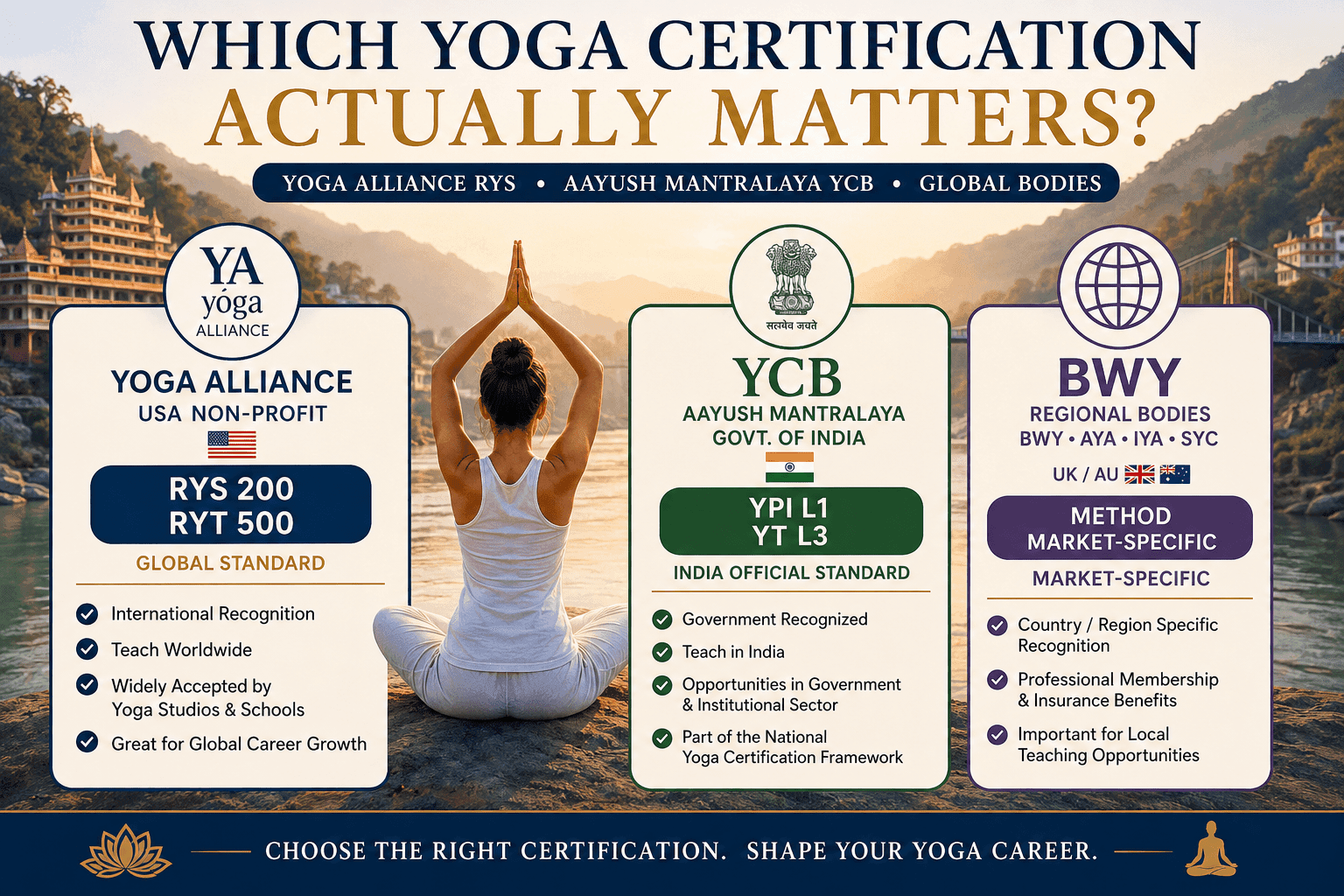
Yoga Alliance USA — The Global Standard-Setter (for Now)
What Is Yoga Alliance?
Yoga Alliance is a US-based non-profit membership organisation founded in 1999. It is not a government body, not a university, and not a regulator in any legal sense. What it is — powerfully — is the most internationally recognised brand in yoga teacher credentialing.
Yoga Alliance sets minimum curriculum standards for yoga teacher training programs and registers schools and teachers who meet those standards. Its headquarters are in Washington D.C., and it operates globally through a voluntary membership model.
What Does RYS Mean?
RYS stands for Registered Yoga School. It is the designation Yoga Alliance grants to yoga schools whose teacher training programs meet the organisation’s curriculum and faculty standards. There are several RYS tiers:
RYS 200
A Registered Yoga School authorised to offer 200-hour foundational yoga teacher training. Graduates of an RYS 200 program can apply to become a Registered Yoga Teacher at the 200-hour level (RYT 200) — the industry baseline for entry-level teaching worldwide.
RYS 300
A school registered to offer advanced 300-hour training, designed for teachers who already hold an RYT 200. Graduates can earn the RYT 500 designation (200 + 300 = 500 hours total).
RYS 500
A school whose full curriculum integrates both the 200-hour and 300-hour training into one continuous 500-hour program.
YACEP (Yoga Alliance Continuing Education Provider)
Not a school credential — this designates a provider of continuing education workshops, shorter intensives, or specialised trainings that registered teachers can use to maintain their Yoga Alliance membership status.
What Do the Teacher-Side Credentials Mean?
Credential | What It Means |
|---|---|
RYT 200 | Completed a 200-hr training at an RYS 200 school |
RYT 500 | Completed 500 hours (200 + 300, or an integrated 500) at RYS schools |
E-RYT 200 | RYT 200 with 1,000+ teaching hours and 2+ years since certification |
E-RYT 500 | RYT 500 with 2,000+ teaching hours and 4+ years since certification |
For a deeper comparison of RYT vs E-RYT vs YACEP credentials, read our companion article: Understanding Yoga Alliance Credential Levels: RYT, E-RYT & YACEP Explained
Why Yoga Alliance Matters Internationally
Despite being a voluntary, non-governmental body, Yoga Alliance’s RYT credential is recognised or preferred in:
- Yoga studios across the USA, UK, Canada, Australia, and Europe
- Most wellness resorts and cruise lines hiring yoga instructors
- Most liability insurance providers for yoga teachers
- Online teaching platforms like Yoga International and some studio booking software
For any teacher planning to work internationally — especially in Western markets — Yoga Alliance registration is functionally mandatory.
Criticisms and Limitations of Yoga Alliance
It would be incomplete to discuss Yoga Alliance without acknowledging its critics:
It is a membership organisation, not a regulator. Anyone can start calling themselves a “yoga school.” Yoga Alliance provides a framework, but compliance is largely self-reported.
The 200-hour standard is widely considered insufficient. Many experienced teachers, including senior Iyengar and Ashtanga instructors, argue that 200 hours cannot produce a truly competent teacher. The industry is evolving.
Annual membership fees are required. Yoga Alliance charges schools and individual teachers annual registration fees to maintain RYS/RYT status. Critics argue this creates a pay-to-play dynamic.
It has limited legal standing in India. Yoga Alliance has no regulatory authority over yoga in India. An Indian school calling itself “Yoga Alliance accredited” is voluntarily meeting a foreign NGO’s standards — valuable for international marketing, but carrying no legal weight domestically.
Aayush Mantralaya YCB — India’s Official Yoga Certification
What Is the Ministry of Ayush?
The Ministry of Ayurveda, Yoga & Naturopathy, Unani, Siddha, and Homoeopathy — abbreviated AYUSH — is a department of the Government of India established in November 2014. It functions as the national regulatory body for traditional Indian medicine systems, including yoga.
What Is the Yoga Certification Board (YCB)?
The Yoga Certification Board (YCB) is an autonomous body under the Ministry of AYUSH, established in 2015. Its mandate is to create a standardised, government-backed framework for yoga certification in India — both for practitioners and for professionals (teachers and trainers).
Unlike Yoga Alliance, YCB is backed by the sovereign authority of the Government of India. Its standards are developed in consultation with traditional yoga institutions, AYUSH universities, and the Quality Council of India (QCI).
YCB Certification Levels
The YCB uses a level-based system aligned with India’s National Skills Qualifications Framework (NSQF):
Level 1 — Yoga Protocol Instructor (YPI)
The foundational level. Designed for individuals who want to teach basic yoga classes, typically in schools, community centres, or corporate wellness programs. Approximately 200 hours of training is expected. This is roughly equivalent in scope (though not in content philosophy) to an RYT 200.
Level 2 — Yoga Wellness Instructor (YWI)
An intermediate level for those working in wellness settings — hospitals, clinics, and rehabilitation centres. Requires a strong foundation in therapeutic yoga and yoga philosophy.
Level 3 — Yoga Teacher (YT)
A senior teaching credential for professionals capable of designing comprehensive yoga programs and mentoring junior instructors.
Level 4 — Yoga Master (YM) and Level 5 — Yoga Teacher (YG)
The highest YCB levels, reserved for those with deep traditional knowledge, long teaching experience, and the ability to lead research or institutional yoga programs. These are prestige designations within India’s traditional yoga ecosystem.
Who Is YCB Certification Most Relevant For?
- Teachers wanting to work in Indian government yoga programs (e.g., AYUSH wellness centres, government hospitals)
- Schools participating in the Yoga in Schools national program
- Professionals applying for Yoga Day events and government-organised yoga initiatives
- Practitioners wanting legal recognition of their credentials within India’s regulatory framework
- Those seeking jobs in India’s rapidly growing domestic wellness economy
YCB vs Yoga Alliance: The Core Difference
Dimension | Yoga Alliance (RYS) | Aayush Mantralaya YCB |
|---|---|---|
Nature | Private US non-profit | Indian government body |
Legal authority | None (voluntary) | Government-backed |
Primary market | International (Western) | India-focused |
Recognition abroad | Very high in Western markets | Growing, limited abroad |
Recognition in India | Marketing advantage only | Regulatory/official recognition |
Curriculum philosophy | Open, flexible | NSQF-aligned, traditional |
Cost | Membership fees required | Examination-based, government tariffs |
Teacher benefit | RYT credential for global studios | YPI/YT/YM credential for Indian market |
Other Major Yoga Accreditation Bodies Around the World
Beyond Yoga Alliance and YCB, a growing number of regional and specialty organisations offer yoga teacher credentials. Understanding these is critical for teachers targeting specific markets or disciplines.
Yoga Alliance International (YAI)
Not to be confused with Yoga Alliance USA, Yoga Alliance International is a separate UK-based organisation. It is sometimes preferred by European schools as it aligns better with European quality assurance norms. YAI offers:
- Member School registration (equivalent to RYS)
- Member Teacher registration (equivalent to RYT)
- A level-based CPD (Continuing Professional Development) framework
Relevance: Moderately recognised in the UK, parts of Europe, and some Commonwealth countries. Gaining ground but still far behind Yoga Alliance USA globally.
British Wheel of Yoga (BWY)
The British Wheel of Yoga is the governing body for yoga in the United Kingdom and is recognised by Sport England. BWY accreditation is highly respected within the UK and is often a prerequisite for yoga teachers wishing to work in British schools, NHS settings, or through UK physical education bodies.
BWY teacher training is typically longer (3–4 years part-time) and more academically rigorous than a 200-hour intensive. For teachers focused on the UK market, BWY is arguably more valuable than Yoga Alliance.
Relevance: Essential for UK-based teachers. Less recognised outside the UK.
Australian Yoga Alliance (AYA)
The Australian Yoga Alliance is the primary yoga accrediting body in Australia. Like Yoga Alliance USA, it is a non-profit membership organisation, but it operates independently. AYA recognises Yoga Alliance USA credentials for membership, making dual-registration straightforward for internationally mobile teachers.
Relevance: Important for teachers working in Australia. Cooperates with Yoga Alliance USA.
European Yoga Alliance (EYA)
A newer body attempting to standardise yoga teacher training across European Union member states. Not yet widely adopted, but worth watching as EU discussions around formalising wellness profession standards continue.
Iyengar Yoga Association (IYA / IYAGB in the UK)
The Iyengar Yoga Association is method-specific — it certifies teachers in the Iyengar style of yoga exclusively. Iyengar certification is among the most rigorous in the world, requiring years of study, multiple assessment levels, and ongoing mentorship. An Iyengar-certified teacher commands exceptional respect in yoga communities globally.
Relevance: Essential for Iyengar teachers. Internationally respected. Method-specific.
Ashtanga Yoga Institute (KPJAYI / Sharath Yoga Centre)
The Sharath Yoga Centre (SYC) in Mysore, formerly KPJAYI, is the traditional source of Ashtanga Vinyasa yoga lineage. Teachers authorised or certified by SYC hold the highest possible standing within the Ashtanga community. This is a lineage-based, not hours-based, system.
Relevance: Critical for Ashtanga teachers. Globally respected within the style.
Sivananda Yoga Vedanta Organisation
The Sivananda network runs its own teacher training programs (TTC) based on the classical teachings of Swami Sivananda and Swami Vishnudevananda. Sivananda TTC graduates receive a Sivananda certificate, which is widely recognised among classical yoga communities globally.
Relevance: Well-respected internationally, especially in traditional and spiritual yoga communities.
How Do These Bodies Compare for Indian Yoga Schools?
For a school like Tratak Yoga Academy, operating from Rishikesh with an international student base, the question is practical: which accreditation frameworks best serve students from different countries?
The Dual Accreditation Reality
Most serious Indian yoga schools today hold — or aspire to hold — both Yoga Alliance USA accreditation and YCB recognition. Here’s why:
Yoga Alliance RYS accreditation serves your international students. A student from Germany, Australia, or Brazil who completes your 200-hour program can register as an RYT 200 with Yoga Alliance USA and teach at studios in their home country. This is non-negotiable for most schools with a significant international student base.
YCB certification serves your domestic mission. Indian students who want to work in government hospitals, AYUSH centres, or participate in national yoga programs need YCB credentials. It also demonstrates that your school aligns with India’s traditional yoga values and government quality standards.
What About Multi-Style or Specialty Certifications?
If your school offers programs in specialisations like Prenatal Yoga, Yoga Nidra, or Sound Healing, the relevant question shifts from which body to which body recognises this specialty. Yoga Alliance USA has a growing list of YACEP-approved specialty training providers. YCB is developing specialty frameworks as well, though these are less mature.
Related article: 85-Hour Prenatal & Postnatal Yoga Teacher Training — Everything You Need to Know
Practical Guidance: Which Certification Is Right for You?
If You Want to Teach in India’s Domestic Market
Prioritise YCB certification. Combine it with Yoga Alliance if possible, but the YCB credential carries official weight in India’s growing wellness economy — and increasingly in government-linked employment.
If You Want to Teach Internationally (Especially in the West)
Yoga Alliance RYT is the baseline requirement. Without it, many international studios simply won’t hire you, regardless of your actual skill level. Earn your RYT 200 from a reputable RYS 200 school in Rishikesh, then build toward RYT 500 and E-RYT with experience.
If You Want to Teach in the UK
Get your RYT first, then seriously consider working toward BWY accreditation or at least taking BWY-affiliated CPD courses. The UK market values BWY more highly than most Indian schools acknowledge.
If You Practice a Specific Method
Follow the lineage. Iyengar practitioners must earn Iyengar certification. Ashtanga practitioners should pursue Mysore authorisation. These method-specific credentials hold more weight in their communities than any generalist body.
If You’re Undecided or Teaching Multiple Styles
Start with Yoga Alliance RYT 200 from a reputable RYS school. It provides the widest international flexibility. Add specialty YACEPs as you develop your niche. Pursue YCB if you plan to work significantly within India.
Key Takeaways
- Yoga Alliance RYS is a US-based voluntary accreditation body. Its RYT credentials are the global industry standard for international teaching, particularly in Western markets. Being an RYS 200 or RYS 500 school signals to international students that your training meets globally recognised standards.
- Aayush Mantralaya YCB is the Indian government’s official yoga certification framework. It carries regulatory and legal recognition within India and is increasingly important for teachers wishing to work in government wellness programs, schools, and healthcare settings domestically.
- Yoga Alliance International, BWY, AYA, and other regional bodies matter for specific geographic markets. UK teachers should take BWY seriously. Australian teachers benefit from AYA registration.
- Method-specific bodies (Iyengar, Ashtanga/SYC, Sivananda) operate outside the generalist credentialing world and carry enormous weight within their traditions — often more than any Yoga Alliance designation.
- For most international students training in India, Yoga Alliance RYT 200 from an RYS-accredited school in Rishikesh remains the optimal starting credential. For Indian nationals planning domestic careers, combining RYT with YCB is the strongest position.
- No single body “owns” yoga. The ecosystem is deliberately diverse, and a thoughtful teacher earns credentials that match their market, their method, and their values — not just whatever seems most prestigious on a brochure.
Frequently Asked Questions (Schema-Ready FAQ)
Q1: What is the difference between Yoga Alliance RYS and YCB?
Yoga Alliance RYS (Registered Yoga School) is an accreditation granted by Yoga Alliance USA, a private non-profit organisation. It is the most widely recognised yoga school credential internationally, especially in Western markets. YCB (Yoga Certification Board) is a certification framework operated by India’s Ministry of AYUSH — the Government of India. It carries legal and regulatory standing within India and is the official national standard for yoga teacher credentials. An RYS accreditation helps a school attract international students; a YCB credential helps teachers work within India’s official wellness ecosystem.
Q2: Is Yoga Alliance certification valid in India?
Yoga Alliance certification is not legally regulated in India — it carries no government mandate. However, it is widely recognised by international yoga communities, premium wellness resorts, and global studios. Many international students choose to train at Yoga Alliance-accredited schools in India specifically to earn an RYT credential that will be recognised in their home countries. For working within India’s official government programs, YCB certification is the appropriate credential.
Q3: Which yoga certification is best for teaching abroad?
For teaching yoga in the USA, Canada, Australia, most European countries, and the South-East Asian wellness industry, the Yoga Alliance RYT 200 certification is the most widely recognized credential. Advancing to RYT 500 further enhances your credibility and expands your career opportunities.
If you plan to teach in the United Kingdom, it is beneficial to complement your Yoga Alliance certification with training recognized by the British Wheel of Yoga (BWY).
For those specializing in traditional yoga systems such as Iyengar Yoga or Ashtanga Yoga, obtaining certification from the respective lineage or governing organization is highly recommended in addition to your Yoga Alliance credentials. This combination strengthens your professional profile and ensures recognition within those specific teaching traditions.
Q4: Can I get both Yoga Alliance and YCB certification?
Yes. In fact, for Indian nationals with international aspirations, holding both is the strongest professional position. Enroll in a school that is simultaneously a Yoga Alliance-accredited RYS and a YCB-recognised institution. Your school’s admissions team can confirm which credential your specific program qualifies you for.
Q5: What is YACEP in Yoga Alliance?
YACEP stands for Yoga Alliance Continuing Education Provider. It is a designation given to individuals or organisations offering continuing education workshops, specialty trainings, or short courses that registered Yoga Alliance teachers can use to fulfil their CEU (Continuing Education Unit) requirements for annual membership renewal. Tratak Yoga Academy offers several YACEP-eligible specialty programs, including Sound Healing and Pranayama intensives.
Q6: Is the Aayush Mantralaya YCB certification recognised internationally?
YCB certification is primarily recognised within India and in countries with significant Indian diaspora communities or bilateral wellness agreements with India. Its international recognition is growing but remains limited compared to Yoga Alliance. For teaching in Western markets, Yoga Alliance RYT remains the preferred credential. This may evolve as India’s diplomatic influence in global wellness standards grows.
Q7: What is the difference between RYS 200 and RYS 500?
RYS 200 is a Yoga Alliance designation for schools offering 200-hour foundational yoga teacher training programs. RYS 500 is for schools offering 500-hour integrated programs (or schools that offer the full 200 + 300 continuum). Graduating from an RYS 200 school makes you eligible to register as an RYT 200 with Yoga Alliance. Completing 500 hours at a combination of RYS schools makes you eligible for the RYT 500.
Q8: Does Tratak Yoga Academy have Yoga Alliance accreditation?
Yes. Tratak Yoga Academy is an accredited Registered Yoga School (RYS) with Yoga Alliance USA. Our teacher training programs in Rishikesh, Pokhara, and Bali, as well as our online YTT programs, qualify graduates to register directly as Yoga Alliance RYTs upon completion. Contact us or visit tratakyoga.com for current program details and registration.
Q9: What is the British Wheel of Yoga and how does it differ from Yoga Alliance?
The British Wheel of Yoga (BWY) is the governing body for yoga in the United Kingdom, recognised by Sport England. Unlike Yoga Alliance, which is a global membership organisation, BWY is specifically structured around the UK market and often required for teaching in UK schools, hospitals, and NHS wellness programs. BWY teacher training is typically longer and more academically demanding than standard 200-hour intensives. For teachers working in the UK, BWY accreditation often outweighs Yoga Alliance in practical value.
Q10: What yoga certification do I need to teach in India?
There is no single legally mandatory certification to teach yoga privately in India. However, if you wish to work in government AYUSH programs, public schools, government hospitals, or national yoga events, the YCB (Yoga Certification Board) credential is increasingly important. For private studios, wellness resorts, and international-facing teaching in India, Yoga Alliance RYT is widely preferred by employers. Ideally, teachers in India should hold both.
About Tratak Yoga Academy
Tratak Yoga Academy is a Yoga Alliance USA-accredited yoga school with campuses in Rishikesh (India), Pokhara (Nepal), and Bali (Indonesia), as well as a comprehensive online yoga teacher training program. Founded in the tradition of classical Himalayan yoga, Tratak blends authentic ancient practices — including Pranayama, and yogic philosophy — with modern pedagogical standards recognised globally.
Our 200-hour, 300-hour, and 500-hour YTT programs are RYS-accredited. Specialty programs in Sound Healing, Prenatal Yoga, and Yoga Nidra are offered as YACEP-eligible continuing education.
📍 Rishikesh | Pokhara | Bali | Online 🌐 tratakyoga.com 📸 @tratakyoga




Comments are closed