
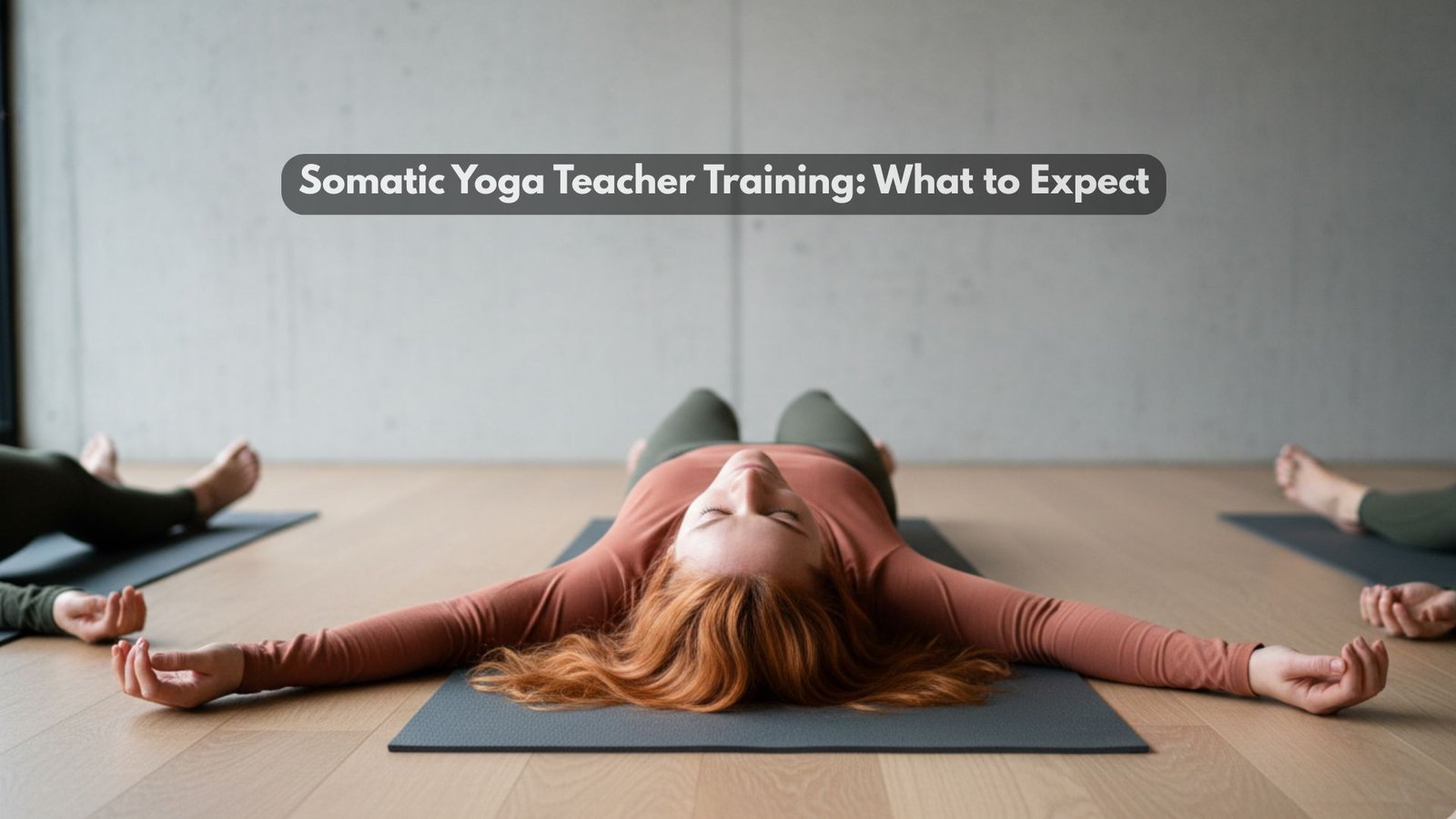
You know that weird moment after a long day when your body feels tight for no clear reason? Like your shoulders are up near your ears and you didn’t even notice when it happened. That’s where most people first get curious about somatic yoga. It doesn’t start with flexibility or fancy poses. It starts with awareness. Small, almost boring movements that somehow hit deeper than a one-hour power class ever did.
I remember a student named Riya who joined a trial class at 7 am because her friend dragged her along. She spent the first ten minutes whispering, “Are we even doing anything?” By the end, she said her lower back felt different. Not fixed. Just… different. That confused her more than anything else.
This guide breaks down what somatic yoga teacher training actually looks like in 2026, what you’ll learn, how it feels in real life, and whether it’s even worth your time.
What is somatic yoga and why people are choosing it now

Let me explain this simply. Somatic yoga is about retraining how your brain and body talk to each other. Instead of stretching harder, you move slower. You pay attention to how a movement feels from the inside, not how it looks from the outside.
That sounds simple, but it messes with your expectations.
A guy named Arjun once told me he almost walked out in his second class. He said, “I came here to sweat, not to lie on the floor and move my arm like it’s underwater.” Fair point. But he stayed. Two weeks later, he noticed his neck pain during study sessions had dropped. Not gone, just less annoying. That’s usually how it starts.
People are turning to somatic work because regular workouts don’t always fix chronic tension. You can be strong and still feel stuck. This approach goes after that stuck feeling.
If you’re wondering whether you need to be flexible or experienced, you don’t. Most people in training are beginners who just feel disconnected from their own bodies.
Somatic yoga teacher training: how it’s actually structured
The structure is not chaotic, even if the practice feels unfamiliar at first.
You’ll usually go through three layers:
1. Body awareness first
You spend a lot of time noticing small things. How your breath shifts when you turn your head. How one hip feels heavier than the other. It sounds slow because it is slow.
A student named Neha struggled here. She kept asking, “Am I doing this right?” The teacher kept saying, “Just notice.” That annoyed her. She wanted instructions, not questions. After a week, she stopped asking and started observing. That shift matters more than getting a pose perfect.
2. Movement patterns
You learn sequences that look simple but feel surprisingly deep. These are often used in somatic yoga workout sessions. Think slow arching, curling, and releasing patterns.
Here’s the thing nobody really tells you. You might feel awkward. Even bored. That’s normal. Your brain is used to fast feedback. This work doesn’t give that immediately.
3. Teaching practice
You don’t just learn movements. You learn how to guide others. That includes language, pacing, and when to stay quiet.
One trainee, Kunal, spoke too much in his first mock class. He filled every second with instructions. The group looked confused. His teacher told him, “Give people space to feel.” Next session, he said less. The class felt calmer.
If you’re worried about speaking in front of people, yeah, it’s part of the process. But you grow into it.
Somatic yoga for trauma release: what training teaches you

This part needs honesty.
Somatic yoga is often linked with somatic yoga for trauma release, but that doesn’t mean you become a therapist. You’re not trained to treat trauma. You learn how the body stores stress and how gentle movement can help release some of that tension.
I once saw a student named Farah pause mid-class and sit still for five minutes. No breakdown. No drama. She just said later, “I felt something shift and didn’t want to rush it.” That’s the kind of experience that happens.
Training teaches you:
- How to create a safe space
- How to avoid pushing students too far
- How to recognize when someone needs to slow down
A common doubt people have is whether this work can bring up uncomfortable emotions. Sometimes it does. Not always. And not in a dramatic way most of the time. It’s usually subtle.
If you’re planning to teach, you’ll learn how to handle these moments without panicking. Mostly by staying calm and not trying to fix everything instantly.
What a typical day in training feels like
It’s not like a gym schedule.
You might start your day with a slow practice that feels almost too easy. Then theory sessions. Then partner work.
A guy named Dev used to check his phone during breaks and complain that he wasn’t “tired enough.” By week two, he stopped doing that. He said he felt mentally tired instead. That’s a different kind of fatigue.
Here’s a rough idea of a day:
- Morning somatic session
- Short discussion or reflection
- Anatomy basics explained in simple terms
- Practice teaching in small groups
You won’t leave drenched in sweat. You’ll leave thinking more about how you move without noticing.
Does that sound like something you’d enjoy, or does it feel too slow for you? That question matters more than anything else.
Somatic yoga at home vs in training programs
A lot of people start with somatic yoga at home. Videos, short routines, maybe a free guide.
That’s fine. It helps you get familiar.
But training is different because of feedback.
A student named Pooja practiced at home for months. She thought she understood the movements. During training, a teacher pointed out that she was rushing through everything. She didn’t even realize it.
That’s the gap. When you practice alone, you miss small details.
If you’re serious about teaching, you need that correction. If you’re just curious, home practice is enough to start.
And if you want to build a base, you can combine it with something like a beginner-friendly approach from Beginners guide to meditation where awareness practices are explained in a simple way. It actually helps your somatic sessions feel less confusing.
Building your own somatic yoga plan during training
You won’t just follow routines. You’ll learn to build your own somatic yoga plan.
This part confuses people at first.
A trainee named Aman kept asking for “the perfect sequence.” He wanted a fixed routine. His teacher told him there isn’t one. Your plan depends on what your body needs that day.
That sounds vague, but here’s how you actually do it:
- Start with awareness
- Add one or two movement patterns
- End with rest and observation
That’s it. Not complicated.
Over time, you learn how to adjust. Tight hips one day, stiff neck another day.
If you like structure, this might frustrate you at first. But it also gives you freedom once you get used to it.
Somatic yoga for men: breaking the awkward barrier
Let’s talk about something real. A lot of men feel weird walking into a slow, awareness-based class.
A guy named Rohit told me he almost didn’t join because he thought it would be “too soft.” First session, he kept looking around to see if he was doing it right. Second session, he stopped caring.
That shift takes time.
Somatic yoga for men isn’t different in terms of technique. The difference is in mindset. You drop the idea that you need to perform or push harder.
If you’re someone who lifts weights or plays sports, this can actually help you recover better. Not instantly. But gradually.
And no, you don’t need to become super flexible. Most people don’t.
Where this fits with traditional yoga training
You might be wondering how this compares to regular yoga teacher training.
Traditional programs focus more on postures, alignment, and sometimes philosophy. Somatic training focuses on internal awareness.
Both have value.
Some students actually combine the two. For example, if you’re already looking at a structured path like a 200 hour yoga teacher training in Rishikesh, adding somatic work later can deepen your teaching style.
A student named Mehul did exactly that. He completed a traditional course first. Then he felt something was missing in how he connected with students. Somatic training helped him slow down his teaching.
You don’t have to choose one forever. You can build your own style over time.
What nobody tells you about this training
Here’s the honest part.
You might get bored.
You might question whether you’re learning anything.
A trainee named Sneha said in week one, “This feels too basic.” By week three, she realized she had been rushing every movement in her life. That realization didn’t come from a lecture. It came from repetition.
Another thing. Progress is not obvious. You won’t suddenly feel “fixed.” You’ll notice small changes.
Less tension while studying. Better sleep some nights. Slightly easier breathing.
If you expect dramatic results, you’ll get frustrated. If you stay patient, it starts to make sense.
Should you actually do a somatic yoga teacher training
This depends on what you want.
If you’re looking for something intense and fast, this might feel slow.
If you’re curious about how your body actually works from the inside, this is worth trying.
A student named Kavya joined just to fix her posture. She didn’t care about teaching. By the end, she still slouched sometimes, but she noticed it quicker. That awareness changed how she sat during long study sessions.
So the question isn’t “Is this the best training?”
It’s “Does this match what I need right now?”
Take a moment and think about that.
Wrapping it up: what this guide really showed you
This guide walked you through what somatic yoga training actually looks like in 2026, from daily structure to teaching practice and real student experiences.
It’s slower than most people expect. Sometimes confusing. Often subtle.
But it teaches you something most workouts ignore. How to feel what’s happening inside your own body without rushing to fix it.
If you’re interested, start small this week. Try a short session at home. Notice how your body feels before and after. Don’t overthink it.
And if you’re serious about going deeper, look into structured programs or even combine it with a broader yoga path like a retreat or training program. You can explore options like Yoga Retreat in India to see how different approaches feel in a real setting.
That’s probably the best way to decide. Not by reading more. By actually trying it.
FAQs
1. What is somatic yoga in simple terms?
It’s a slow movement practice where you focus on how your body feels instead of how it looks. You retrain your brain to release tension patterns. It’s less about stretching and more about awareness.
2. Can somatic yoga help with trauma?
It can support the body in releasing stored tension linked to stress. But it’s not therapy. In training, you learn to guide safely without trying to treat emotional issues directly.
3. Is somatic yoga good for beginners?
Yes, most people start as beginners. You don’t need flexibility or prior yoga experience. In fact, starting fresh sometimes makes it easier to learn.
4. How is somatic yoga different from regular yoga?
Regular yoga often focuses on poses and alignment. Somatic yoga focuses on internal sensation and slow movement. The pace and intention are different.
5. Can I practice somatic yoga at home?
You can start at home with simple routines. But training helps because you get feedback and correction. That makes a big difference over time.





Comments are closed