
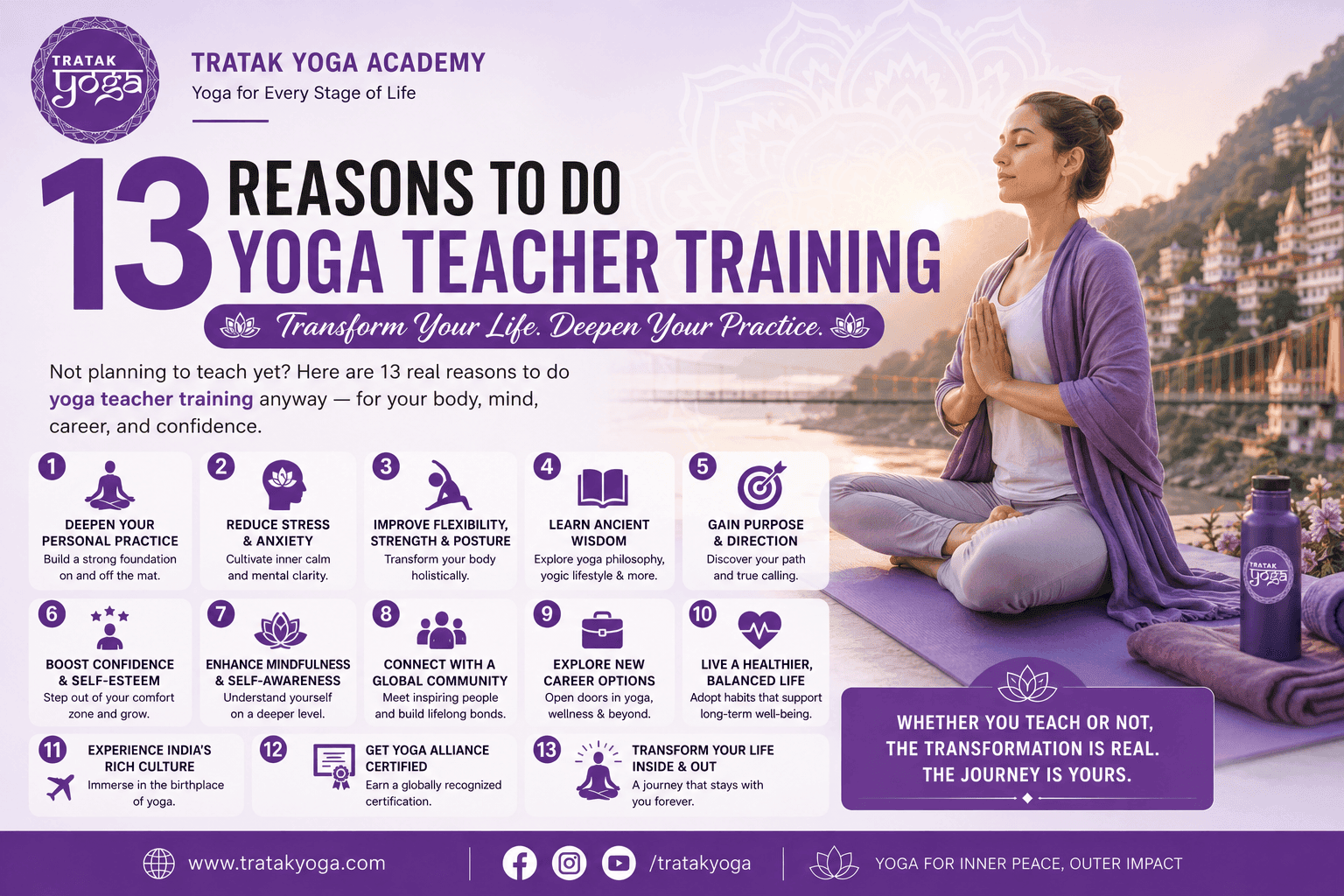
13 Reasons to Do Yoga Teacher Training (Even If You Never Plan to Teach)
A clear, honest look at why thousands of people sign up for yoga teacher training every year — and most of them aren’t chasing a teaching career at all.
Key Takeaways
- Yoga teacher training isn’t only for people who want to become full-time yoga teachers. Many students join purely to deepen their own practice.
- The training builds real, transferable skills — public speaking, anatomy knowledge, breath control, and stress management — that help in everyday life and other careers.
- It’s one of the few experiences that combines physical training, mental discipline, and community into a single, structured program.
- A good YTT changes how you understand your body. It also changes how you handle stress, and how you show up for other people.
- You don’t need to be flexible, young, or “advanced” to start. You just need curiosity and consistency.
Introduction: You Don’t Need to Want to Teach
Here’s something most people don’t expect before their first yoga teacher training: not everyone in the room wants to teach.
Walk into almost any 200-hour YTT program today, and you’ll find lawyers, engineers, new parents, retirees, and long-time yoga students who simply want to go deeper. Some never plan to lead a single class. They’re there for something else entirely.
That “something else” is what this article is about. Below are 13 real, practical reasons people choose to do yoga teacher training — whether or not teaching is part of the plan. Some reasons are physical. Some are mental. A few might surprise you.
At Tratak Yoga Academy, we see this pattern every single course, across our campuses in Rishikesh, Pokhara, and Bali, and in our online programs. Teaching certification is often the reason people sign up. It’s rarely the only reason they stay.
Explore our 200-hour YTT program In Rishikesh, India
Thirteen Reasons to Do Yoga Teacher Training
1: You’ll Finally Understand Your Own Practice
From “Doing Poses” to Understanding Why
Most yoga students learn poses by copying a teacher. That works, up to a point. But it doesn’t explain why a pose feels the way it does, or what it’s actually doing to your body.
Teacher training changes that. You learn the mechanics behind each pose — which muscles engage, which joints move, and why alignment matters. Your practice stops being imitation. It becomes understanding.
This Shift Is Permanent
Once you understand the “why” behind a pose, you can’t really unlearn it. Even years later, your practice stays sharper and more intentional than before training.
2: It Builds Real Physical Strength and Flexibility
Teacher training is physically demanding. Most programs include daily practice, sometimes twice a day, for several weeks straight.
That consistency does something a once-a-week studio class can’t. It builds strength, flexibility, and stamina fast. Many graduates say their bodies feel stronger after training than after years of casual practice before it.
3: You Learn to Manage Stress From the Inside Out
Pranayama Isn’t Just “Breathing Exercises”
Every YTT program teaches pranayama — controlled breathing techniques used in yoga. These aren’t just warm-up exercises. They’re practical tools for managing anxiety, racing thoughts, and everyday stress.
A Skill You’ll Use for the Rest of Your Life
Once you learn techniques like alternate nostril breathing or the calming breath used in Sitali pranayama, you carry them with you. You can use them in a stressful meeting, before a hard conversation, or in the middle of a sleepless night.
This is one of the most quietly life-changing parts of training. It rarely gets talked about as much as the poses. It probably should.
4: It Teaches You Anatomy — Without a Medical Degree
You don’t need to be a doctor to understand how your body works. But most people go their whole lives without learning the basics.
Yoga teacher training changes that. You’ll learn the skeletal system, the muscular system, and how breath and movement connect to both. This knowledge helps you move safely, avoid injury, and understand your own body’s signals.
It Also Helps You Help Others
Even if you never teach a class, this knowledge is useful. You’ll notice when a friend or family member is moving in a way that could hurt them. You’ll have real, useful things to say.
5: You Gain Genuine Self-Confidence
Public Speaking Practice, Without Calling It That
Most YTT programs include practice teaching. You’ll stand in front of a group, cue a sequence, and lead a class — often for the first time in your life.
This is uncomfortable at first. Almost everyone feels nervous. But by the end of the course, most students are surprised by how much easier public speaking feels.
Confidence That Extends Beyond Yoga
This confidence doesn’t stay on the mat. Former students often say they feel more comfortable speaking up at work, leading meetings, or simply expressing their opinions after training.
6: It’s a Genuine Reset Button
Life gets loud. Between work, family, and constant notifications, most people rarely get real, uninterrupted time to think.
A residential yoga teacher training program removes you from that noise. No constant emails. No daily errands. Just practice, study, rest, and reflection, for several weeks in a row.
Many students describe this as the first real break they’ve taken in years — not a vacation, but a genuine reset.
7: You’ll Build a Community That Actually Understands You
Shared Struggle Creates Real Bonds
Waking up at 5:30 AM with a room full of strangers creates a strange kind of closeness. You struggle through the same early mornings. All wobble through the same balancing poses. You cheer each other on during practice teaching.
By the end of the course, strangers usually become close friends.
A Global Network, Not Just a Local One
Many YTT programs, especially in India, attract students from dozens of countries. That means your new community isn’t local. It’s global — a genuine network of people you can visit, message, or practice with for years after training ends.
8: It Deepens Your Understanding of Yoga Philosophy
There’s More to Yoga Than the Physical Practice
Asana, the physical poses, is only one part of yoga. The tradition also includes deep philosophical teachings — like the Yoga Sutras of Patanjali, the eight limbs of yoga, and concepts like karma, dharma, and non-attachment.
Philosophy That Applies to Real Life
These teachings aren’t abstract theory. Concepts like non-attachment (aparigraha) or truthfulness (satya) offer real, practical guidance for relationships, work, and daily decisions. Many students say this philosophical training changes how they think more than the physical practice does.
9: It Can Open Real Career Opportunities
Teaching Is Only One Path
Yes, teacher training qualifies you to teach yoga classes. But that’s only the most obvious career path it opens.
Graduates go on to work in corporate wellness programs, hospitals, schools, retreat centers, and private coaching. Some combine it with existing careers, like physiotherapy, nursing, or HR, to bring yoga-informed tools into their existing work.
A Credential That Signals Discipline
Even outside the yoga world, completing a demanding, immersive training program signals discipline and commitment. Employers notice that, even in unrelated fields.
10: You Learn to Slow Down and Actually Rest
Most people are bad at resting. We scroll instead of sleep and we multitask instead of pausing. We call exhaustion “productivity.”
Yoga teacher training directly confronts this. Practices like Yoga Nidra and Savasana teach your body and mind what real rest actually feels like, often for the first time in years.
This skill matters. Left unlearned, chronic low-level exhaustion quietly affects health, mood, and relationships for years.
11: It Improves How You Handle Difficult Emotions
The Mat as a Mirror
Yoga has a well-known reputation for surfacing emotion. Certain poses, especially deep hip openers, are known to bring up unexpected feelings — frustration, sadness, or even tears.
Teacher training, with its daily practice and reflection, brings this up more than casual classes do. And that’s a good thing.
Learning to Sit With Discomfort
Instead of avoiding these feelings, training teaches you to notice them, breathe through them, and let them pass. This single skill — sitting with discomfort instead of running from it — is one of the most valuable, transferable lessons of the entire course.
12: You’ll Learn to Read and Adapt to Different Bodies
Even if you never teach professionally, you’ll learn something valuable: not every body moves the same way.
Training teaches you modifications, props, and adjustments for different bodies, injuries, and ability levels. This makes you a better practice partner, a safer training buddy, and a more thoughtful presence in any group fitness setting.
13: It Might Just Change the Direction of Your Life
The Reason People Don’t Expect
This last reason is hard to plan for, and even harder to explain to someone who hasn’t experienced it. Many graduates describe their teacher training as a genuine turning point — not because of the certificate, but because of who they became during the process.
A Common Story
New teachers. Career changers. People who finally leave a job that wasn’t working. People who move countries, start businesses, or simply become calmer, steadier versions of themselves.
Not everyone has this experience. But enough people do that it’s worth naming as its own, very real reason to consider training.
Who Should NOT Expect to Become a Full-Time Yoga Teacher After This
Let’s be honest for a moment. Not everyone who completes a 200-hour YTT goes on to teach professionally, and that’s completely fine.
If your main goal is building a full-time teaching career, treat the 200-hour training as a strong foundation, not a finish line. Real teaching confidence usually comes from continued practice, mentorship, and real classroom experience after certification.
If your goal is personal growth, deeper practice, or simply trying something meaningful, the 200-hour training is often exactly enough on its own.
Explore our 300-hour YTT program In Rishikesh, India
What to Expect From a Typical 200-Hour YTT
- Duration: Most residential programs run 3 to 4 weeks; part-time and online formats can spread over several months
- Daily structure: Morning and evening practice, philosophy lectures, anatomy classes, and practice teaching sessions
- Core subjects: Asana, pranayama, meditation, anatomy, philosophy, and teaching methodology
- Assessment: Usually a mix of practical teaching demonstration and written evaluation
- Outcome: A Yoga Alliance-recognized certification, if the school is properly accredited
Explore our 300-hour YTT program In Pokhara Nepal
How to Choose the Right Program for You
- Check accreditation. Look for Yoga Alliance registration or an equivalent recognized body.
- Look at the daily schedule. Make sure it matches the intensity level you’re ready for.
- Research the faculty. Experienced teachers make a bigger difference than a fancy location.
- Read real reviews, not just curated testimonials on a school’s own website.
- Ask what happens after graduation. Good schools offer some form of continued support or community.
Explore our 200-hour YTT program In Pokhara Nepal
Frequently Asked Questions
Do I need to be flexible to start yoga teacher training?
No. Flexibility is not a requirement to begin training. Programs are designed to meet students at their current level and build strength and flexibility gradually throughout the course.
Can I do yoga teacher training if I never plan to teach?
Yes. Many students join purely for personal growth, deeper practice, and the physical and mental benefits of the immersive experience, with no intention of teaching professionally afterward.
How long does a yoga teacher training program usually take?
Most foundational programs are 200 hours, typically completed in 3 to 4 weeks for residential formats, or spread across several months for part-time and online formats.
Is yoga teacher training physically hard?
It can be demanding, especially in residential formats with two daily practice sessions. However, programs are generally structured to accommodate a range of fitness and experience levels, with modifications available throughout.
What’s the difference between a 200-hour and a 300-hour yoga teacher training?
A 200-hour training is the foundational certification covering core asana, philosophy, anatomy, and teaching methodology. A 300-hour training is an advanced program, usually taken after the 200-hour level, that goes deeper into specialized topics and refined teaching skills.
Will yoga teacher training help with stress and anxiety?
Many students report meaningful improvements in stress management, largely due to daily pranayama and meditation practice built into the training. It should not, however, replace professional support for diagnosed anxiety or other mental health conditions.
Is yoga teacher training worth it if I already have a full-time career?
Many students complete training alongside or between existing careers, using the skills, discipline, and calm it builds in their everyday professional life, even without a plan to teach. Whether it’s “worth it” ultimately depends on what you’re hoping to get out of it — professional growth, personal growth, or both.
A Note From Tratak Yoga Academy
If you’re on the fence about yoga teacher training because you’re “not sure you want to teach,” you’re not alone. Most people who sign up feel exactly the same way. As a Yoga Alliance USA-accredited school with campuses in Rishikesh, Pokhara, and Bali, we’ve watched hundreds of students arrive unsure of their reasons and leave with a very clear one, even if it wasn’t the one they expected. Sometimes the certificate is just the receipt for something much bigger that happens along the way.
This article reflects general information about yoga teacher training programs. Individual outcomes vary by student, program, and personal effort.
Explore different meditation styles




Comments are closed