
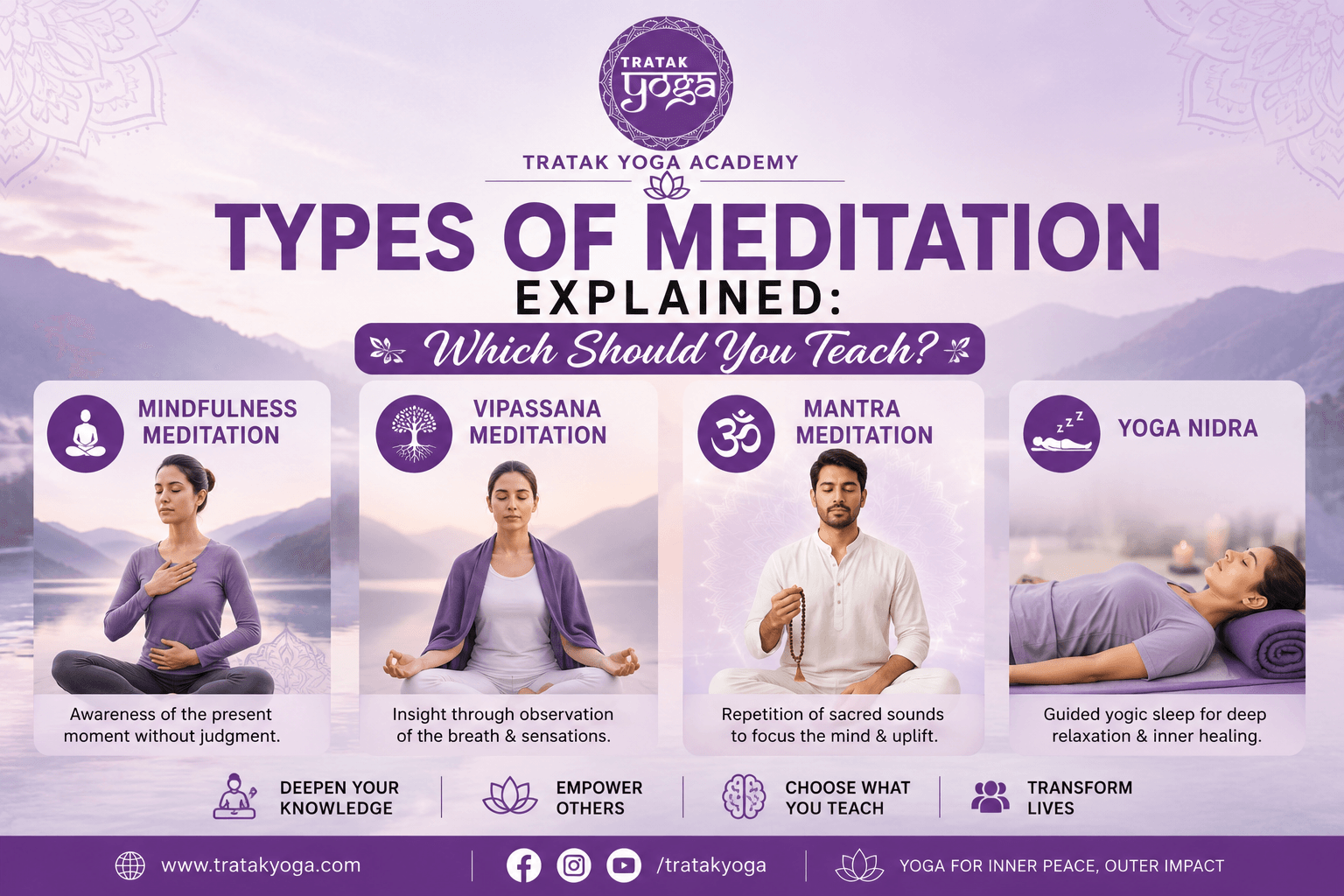
Different Types of Meditation Explained: Which One Should You Teach?
A grounded, tradition-respecting comparison of Mindfulness, Vipassana, Mantra Meditation, and Yoga Nidra — written for practitioners deciding what to learn, and for yoga teachers deciding what to teach.
Key Takeaways
- Mindfulness, Vipassana, Mantra Meditation, and Yoga Nidra are four of the most widely practiced and most frequently searched meditation styles — but they come from different lineages, use different techniques, and serve different purposes.
- Mindfulness is largely a Western-adapted, secular umbrella term rooted in Buddhist sati practice; Vipassana is its more traditional, intensive Buddhist source practice focused on insight into impermanence; Mantra Meditation uses sound and repetition rooted in Vedic tradition; Yoga Nidra is a guided, lying-down practice from the tantric-yogic tradition aimed at deep conscious relaxation.
- There’s no single “best” meditation style — the right one depends on the practitioner’s goals (stress relief, spiritual insight, sleep, concentration) and, for teachers, on which population they want to serve.
- Choosing which meditation to teach should be based on genuine, sustained personal practice and proper training — not simply on which style trends best on social media.
- Many well-rounded meditation teachers eventually train across more than one tradition, since different students respond to different techniques.
Introduction: Why “Meditation” Is Not One Thing
Ask ten people what meditation is, and you’ll likely get ten different mental images — someone sitting cross-legged watching their breath, someone silently repeating a Sanskrit word, someone lying on their back listening to a guided voice, or someone simply trying to “clear their mind” in a park.
All of these are meditation. None of them are the same meditation.
This confusion isn’t trivial, especially for aspiring yoga and meditation teachers. Committing to teach “meditation” without first understanding which specific tradition and technique you’re actually drawing from is a little like committing to teach “yoga” without knowing the difference between Hatha, Ashtanga, and Yin. The umbrella term hides enormous differences in technique, lineage, intention, and appropriate use.
This guide breaks down four of the most searched-for and most commonly taught meditation styles — Mindfulness, Vipassana, Mantra Meditation, and Yoga Nidra — in depth: their origins, their technique, who they tend to help most, and what it actually takes to teach each one responsibly. Whether you’re a practitioner trying to find the right practice for yourself, or a yoga teacher trying to decide which meditation specialization to pursue, this guide is built to give you a genuinely informed starting point.
At Tratak Yoga Academy, meditation has never been treated as a single, interchangeable module bolted onto asana training. Across our Rishikesh, Pokhara, Bali, and online programs, we teach these traditions as distinct disciplines — because that’s what genuinely honoring them, and teaching them well, requires.
How to Read This Guide
Each meditation style below is explored across four consistent lenses:
- Origin and Lineage — where the practice comes from
- Technique — what you actually do
- Primary Benefits — what it tends to be most effective for
- Who Should Consider Teaching It
Mindfulness Meditation
Origin and Lineage
Mindfulness meditation, as it’s practiced in most Western wellness spaces today, traces back to the Buddhist concept of sati — a Pali word often translated as “awareness” or “remembering to pay attention.” It gained mainstream traction largely through Jon Kabat-Zinn’s Mindfulness-Based Stress Reduction (MBSR) program, developed in the late 1970s, which deliberately secularized Buddhist mindfulness practices for use in clinical and medical settings.
It’s important to name this clearly: modern “mindfulness” is an adaptation, not the original practice in its full religious and philosophical context. That doesn’t make it less valuable — but a responsible teacher should know and be able to explain this lineage rather than presenting it as a spiritually neutral invention.
Technique
At its core, mindfulness meditation involves:
- Anchoring attention on a single point of focus — most often the breath, though sometimes bodily sensation or sound
- Noticing when the mind wanders (which it will, constantly) without judgment
- Gently returning attention to the anchor, again and again
This “notice, don’t judge, return” loop is the entire practice. Its apparent simplicity is deceptive — the skill lies in the quality of attention brought to each return, not in achieving an unwavering, wandering-free mind.
Common Mindfulness Formats
- Breath-focused mindfulness — attention rests on the sensation of breathing
- Body scan meditation — systematic attention moving through different areas of the body
- Mindful movement — walking meditation, or mindfulness brought into simple physical tasks
- Open awareness / choiceless awareness — a more advanced form where attention rests on whatever arises, rather than a single anchor
Primary Benefits
Mindfulness meditation has the largest body of clinical research behind it of the four styles covered here, given its integration into medical and psychological settings over the past several decades. It’s most commonly associated with reduced perceived stress, improved emotional regulation, and better attentional control with consistent practice.
Who Should Consider Teaching Mindfulness
Mindfulness is often the most accessible entry point for teachers wanting to work with general wellness populations, corporate clients, schools, or clinical-adjacent settings (in partnership with, not replacement of, licensed mental health professionals). If your interest is in secular, evidence-informed, broadly applicable meditation instruction, mindfulness is frequently the natural starting specialization.
Vipassana Meditation
Origin and Lineage
Vipassana, meaning “to see things as they truly are,” is one of Buddhism’s oldest meditation techniques, with roots tracing back over 2,500 years. Unlike the adapted, secularized form of mindfulness common in the West, Vipassana as taught in traditional centers — most famously through the S.N. Goenka lineage — retains its original framework as a path toward insight into the three marks of existence: impermanence (anicca), suffering (dukkha), and non-self (anatta).
Technique
Vipassana typically progresses through stages:
- Anapana — initial concentration practice focused purely on the sensation of breath at the nostrils, used to steady and sharpen attention
- Body scanning — systematically moving attention through the body to observe physical sensations exactly as they are, without reacting to them
- Equanimity training — the central skill of Vipassana: observing sensation (pleasant, unpleasant, or neutral) without craving or aversion, which is understood to be the direct mechanism through which the practice reduces suffering over time
The 10-Day Silent Retreat Format
Traditional Vipassana is most commonly associated with intensive, residential 10-day silent retreats — a demanding format involving multiple hours of seated practice daily, complete silence, and no reading, writing, or physical exercise. This format is not incidental; it’s considered central to how the practice creates deep, sustained insight rather than surface-level relaxation.
Primary Benefits
Because Vipassana asks practitioners to observe sensation without reactive craving or aversion, long-term practitioners often report a meaningful shift in their relationship to difficult emotions and physical discomfort — not because the discomfort disappears, but because the habitual reactivity to it softens.
Who Should Consider Teaching Vipassana
Vipassana teaching is a significant undertaking, generally requiring years of personal practice, often including multiple completed 10-day (or longer) retreats, before pursuing any teaching role. This is not a specialization to add casually to a general yoga teaching resume — it demands deep personal experience with the practice’s full intensity, ideally under an established teacher or lineage. Those drawn to serious, long-form contemplative teaching, rather than shorter wellness-format classes, are the natural fit here.
Mantra Meditation
Origin and Lineage
Mantra meditation is rooted in the Vedic tradition of India, with mantra practice appearing throughout the Vedas, Upanishads, and later Tantric and Bhakti traditions. Unlike mindfulness and Vipassana’s emphasis on silent, breath-based observation, mantra meditation is built on sound — specifically, the repetition of a word, phrase, or seed syllable (bija mantra) believed to carry a particular vibrational and psychological effect.
Technique
- Selecting a mantra — this may be a universal mantra (such as Om or So Hum), a deity-associated mantra, or, in some traditions, a personal mantra given by a teacher during initiation (diksha)
- Repetition (Japa) — the mantra is repeated silently, aloud, or in a whisper, often for a fixed count using a mala (108-bead prayer necklace)
- Anchoring attention in sound — rather than watching the breath or bodily sensation, attention rests on the sound and rhythm of the repeated mantra, which naturally displaces distracting thought patterns
Common Mantra Formats
- Japa meditation — silent or whispered repetition using a mala for counting
- Kirtan / call-and-response chanting — a more communal, devotional format often set to music
- Transcendental Meditation (TM) — a specific, trademarked mantra-based technique using a personally assigned sound, taught through a structured, standardized course
Primary Benefits
Mantra meditation’s use of sound as an anchor tends to make it more accessible for practitioners who find pure silent observation (as in mindfulness or Vipassana) difficult to sustain — the rhythmic repetition gives the mind an active “task,” which can lower the barrier to entry for restless or highly analytical minds.
Who Should Consider Teaching Mantra Meditation
Mantra meditation is a strong specialization for teachers already working within a broader yogic or devotional (Bhakti) framework — particularly those teaching in traditions where chanting, kirtan, or Sanskrit study is already part of their offering. It’s also worth noting: teaching mantra meditation authentically involves more than assigning a word to repeat — understanding pronunciation, meaning, and tradition-appropriate use matters, especially when working with Sanskrit mantras drawn from specific lineages.
Build a foundational yoga teaching credential
Yoga Nidra
Origin and Lineage
Yoga Nidra, often translated as “yogic sleep,” draws on ancient tantric practices but was substantially systematized into its modern teachable form in the mid-20th century, most notably by Swami Satyananda Saraswati of the Bihar School of Yoga. It occupies a distinct place among meditation styles: rather than sitting upright, the practitioner lies down in Savasana (corpse pose) throughout the entire practice.
Technique
A typical Yoga Nidra session moves through a structured sequence:
- Settling and intention-setting (Sankalpa) — the practitioner sets a short, positive personal intention at the start of the practice
- Body awareness (rotation of consciousness) — the teacher guides attention systematically through dozens of body parts in a specific sequence, without any physical movement
- Breath awareness — attention shifts to counting or observing the natural breath
- Sensation and opposite pairs — guided awareness of sensations like heaviness/lightness or heat/cold, believed to help release stored tension
- Visualization — often guided imagery, symbolic or narrative in nature
- Return to Sankalpa and gradual awakening — the intention is restated, and the practitioner is slowly guided back to full waking awareness
The Hypnagogic State
What makes Yoga Nidra distinct from most other meditation styles is its deliberate use of the hypnagogic state — the threshold between waking and sleeping. Practitioners are guided to remain conscious and aware while the body enters a state of profound physical rest, which traditional teaching holds allows the practice to bypass ordinary conscious resistance and access deeper layers of relaxation and, in some traditions, the subconscious mind.
Primary Benefits
Yoga Nidra is most commonly sought out for deep physical and nervous-system relaxation, and is frequently used to support better sleep, recovery from burnout, and general nervous system regulation — largely because, unlike seated concentration practices, it requires no physical effort to sustain, making it accessible even to highly fatigued or physically limited practitioners.
Who Should Consider Teaching Yoga Nidra
Yoga Nidra is an excellent specialization for teachers interested in trauma-informed, restorative, or therapeutic yoga spaces, as well as those working with populations facing high stress, insomnia, chronic fatigue, or burnout. Its guided, scripted format also makes it one of the more approachable meditation styles for teachers to develop strong facilitation skills in relatively early in their teaching career — while still requiring genuine study of its structure and intention to teach it well rather than simply reading a generic script aloud.
Side-by-Side Comparison Table
Feature | Mindfulness | Vipassana | Mantra Meditation | Yoga Nidra |
|---|---|---|---|---|
Origin | Buddhist (secularized) | Buddhist (traditional) | Vedic / Tantric | Tantric, modernized |
Posture | Seated | Seated | Seated | Lying down |
Primary Anchor | Breath / body | Breath, then bodily sensation | Sound / repetition | Guided voice, body, breath |
Typical Session Length | 10–30 min | Hours; retreats span days | 15–30 min | 20–45 min |
Best For | General stress reduction, focus | Deep insight, emotional reactivity | Restless minds, devotional practice | Deep rest, nervous system recovery |
Teacher Prerequisite Depth | Moderate | Very high | Moderate to high | Moderate |
Which Meditation Style Should You Teach?
There’s no universally “correct” answer here — but there are useful questions to ask yourself before choosing a specialization.
Ask Yourself: What Is My Own Practice?
The single most important credibility marker in meditation teaching is not certification alone — it’s sustained personal practice. Teaching a style you don’t practice consistently yourself tends to show, subtly but unmistakably, in how you guide others.
Ask Yourself: Who Do I Want to Teach?
- Corporate wellness, general stress management, schools → Mindfulness
- Serious long-term practitioners seeking deep insight work → Vipassana
- Devotional, Bhakti-oriented, or sound-based communities → Mantra Meditation
- Restorative, trauma-informed, sleep-focused, or burnout-recovery populations → Yoga Nidra
Ask Yourself: How Much Time Can I Commit to Training?
Vipassana teaching credibility is built over years, often through direct retreat experience under an established lineage. Yoga Nidra and Mantra Meditation instruction can be developed to a competent teaching level through structured, shorter-format training combined with dedicated personal practice. Mindfulness sits in between, with certification pathways ranging from short courses to extensive, clinically-oriented programs.
You Don’t Have to Choose Only One
Many experienced teachers eventually train across more than one tradition — not to blend them into a generic, undifferentiated “meditation class,” but to be able to genuinely match technique to student need. A teacher who understands all four deeply is far better equipped to guide a restless beginner toward mantra, a burnt-out client toward Yoga Nidra, and a serious long-term student toward Vipassana, rather than offering the same practice to everyone regardless of fit.
How yoga and meditation support nervous system health
A Word on Teaching Responsibly
Across all four styles, one principle remains constant: meditation is not entirely risk-free, and teaching it carries genuine responsibility. While meditation offers profound physical, mental, and emotional benefits, deep meditative states can occasionally bring unresolved emotions or psychological challenges to the surface—particularly in practices such as Vipassana and Yoga Nidra, which intentionally engage the subconscious mind or prolonged awareness of bodily sensations. A responsible meditation teacher should understand these possibilities, recognize when a student’s experience extends beyond their professional scope, and know when to recommend support from a qualified mental health professional.
This is one of the defining characteristics of a high-quality meditation teacher training program. Rather than presenting meditation as a universally gentle, one-size-fits-all practice, it acknowledges its depth, teaches appropriate safeguards, and prepares future teachers to guide students with competence, discernment, and respect for the transformative nature of the practice.
Frequently Asked Questions
What is the main difference between mindfulness and Vipassana?
Mindfulness, as commonly taught in the West, is a secularized adaptation of Buddhist awareness practice focused broadly on present-moment attention. Vipassana is the more traditional, intensive Buddhist source practice, typically taught through structured, multi-day silent retreats and aimed specifically at insight into impermanence and non-reactivity.
Is Yoga Nidra the same as guided meditation?
Yoga Nidra is a specific, structured form of guided meditation with a defined sequence — intention setting, body rotation, breath awareness, sensation work, and visualization — practiced lying down. Not all guided meditations follow this structure, so while Yoga Nidra is a type of guided meditation, not every guided meditation is Yoga Nidra.
Can beginners practice Vipassana meditation?
Yes, although Vipassana is traditionally introduced through structured 10-day residential retreats, these courses are specifically designed to guide beginners under the close supervision of experienced teachers. Rather than encouraging casual self-practice from the outset, the retreat format provides a supportive environment where participants can learn the technique systematically, receive ongoing guidance, and navigate challenges safely.
What is a mantra in meditation?
A mantra is a word, phrase, or sound — such as “Om” or “So Hum” — repeated silently or aloud during meditation to anchor attention and, in many traditions, to invoke a specific vibrational or spiritual effect.
Which meditation style is best for anxiety?
Different styles can help with anxiety in different ways — mindfulness and Yoga Nidra are commonly used for general anxiety and nervous system regulation, while mantra meditation can help restless or ruminative minds through its active sound-based anchor. The most effective choice often depends on individual preference and should be explored under qualified guidance, alongside professional support where anxiety is significant.
Do I need a meditation teacher training certification to teach meditation?
While not always legally required, a structured, tradition-respecting certification is strongly recommended — it ensures you understand not just technique, but contraindications, scope of practice, and how to responsibly hold space for the psychological depth these practices can surface.
How long does it take to become a certified meditation teacher?
This varies significantly by style and program depth — structured trainings can range from a focused week-long intensive to programs spanning several months, with Vipassana teaching credibility in particular typically built over years of sustained personal retreat practice rather than a single certification course.
A Note From Tratak Yoga Academy
Meditation is often the part of a yoga teacher’s training that gets the least dedicated attention — a few sessions folded into a broader YTT, rather than studied as the distinct, lineage-rich discipline it actually is. As a Yoga Alliance USA-accredited school with campuses in Rishikesh, Pokhara, and Bali and a dedicated online program, we treat mindfulness, Vipassana, mantra practice, and Yoga Nidra as what they are: four genuinely different paths, each deserving of real study before anyone teaches them to others.
This article is for educational purposes and reflects general information about meditation traditions and practices. It is not a substitute for guidance from a qualified teacher, and it is not medical or psychological advice.
Read Related Articles: Explore our meditation teacher training programs




How To Choose The Right Yoga Teacher Training Course In India
September 29, 2026[…] considerably in their approach, with some focusing strongly on Hatha, Ashtanga, Vinyasa, Yin, different types of meditation, or a combination of […]
7 Reasons Why Rishikesh Is Popular For Yoga Teacher Training
October 5, 2026[…] Types of Meditation Explained: Which Should You Teach? […]