
By the Faculty at Tratak Yoga Academy, Rishikesh | Updated June 2026
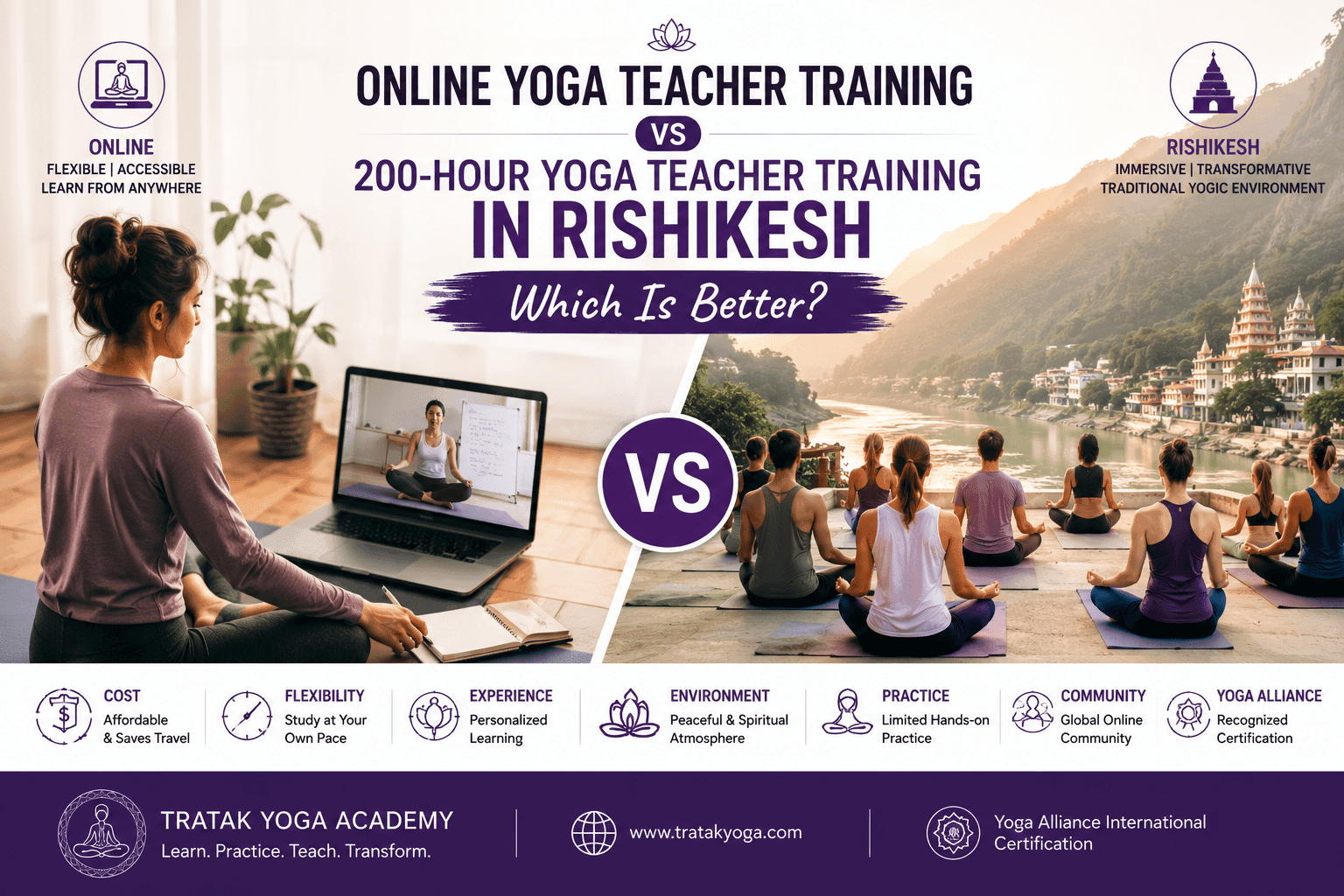
It is one of the most common questions we receive at Tratak Yoga Academy, and it is a genuinely good one: should I come to Rishikesh for my 200-hour yoga teacher training, or can I get equally good training online?
The honest answer — which we’ll give you even though we offer both formats — is that neither is universally better. They are different experiences serving different people at different points in their lives, and the quality of your outcome depends far more on choosing the right format for you than on any abstract ranking of online versus in-person.
What this article does is walk you through every meaningful dimension of that comparison — cost, flexibility, learning depth, community, teaching practice, travel costs, and Yoga Alliance recognition — so that by the end, you know exactly which format fits your situation. We’ll also share our honest perspective on who should choose each path, based on years of training teachers in both formats.
Let’s get into it.
The Big Picture: What Are We Actually Comparing?
Before we compare the two, let’s be precise about what each format means.
A 200-hour Online Yoga Teacher Training delivers the full Yoga Alliance-compliant curriculum — asana, pranayama, meditation, anatomy, philosophy, teaching methodology — through live or pre-recorded classes conducted over video. Students practice in their own homes, submit assignments digitally, and complete a virtual practicum. The course can be spread over weeks or months, often with significant scheduling flexibility.
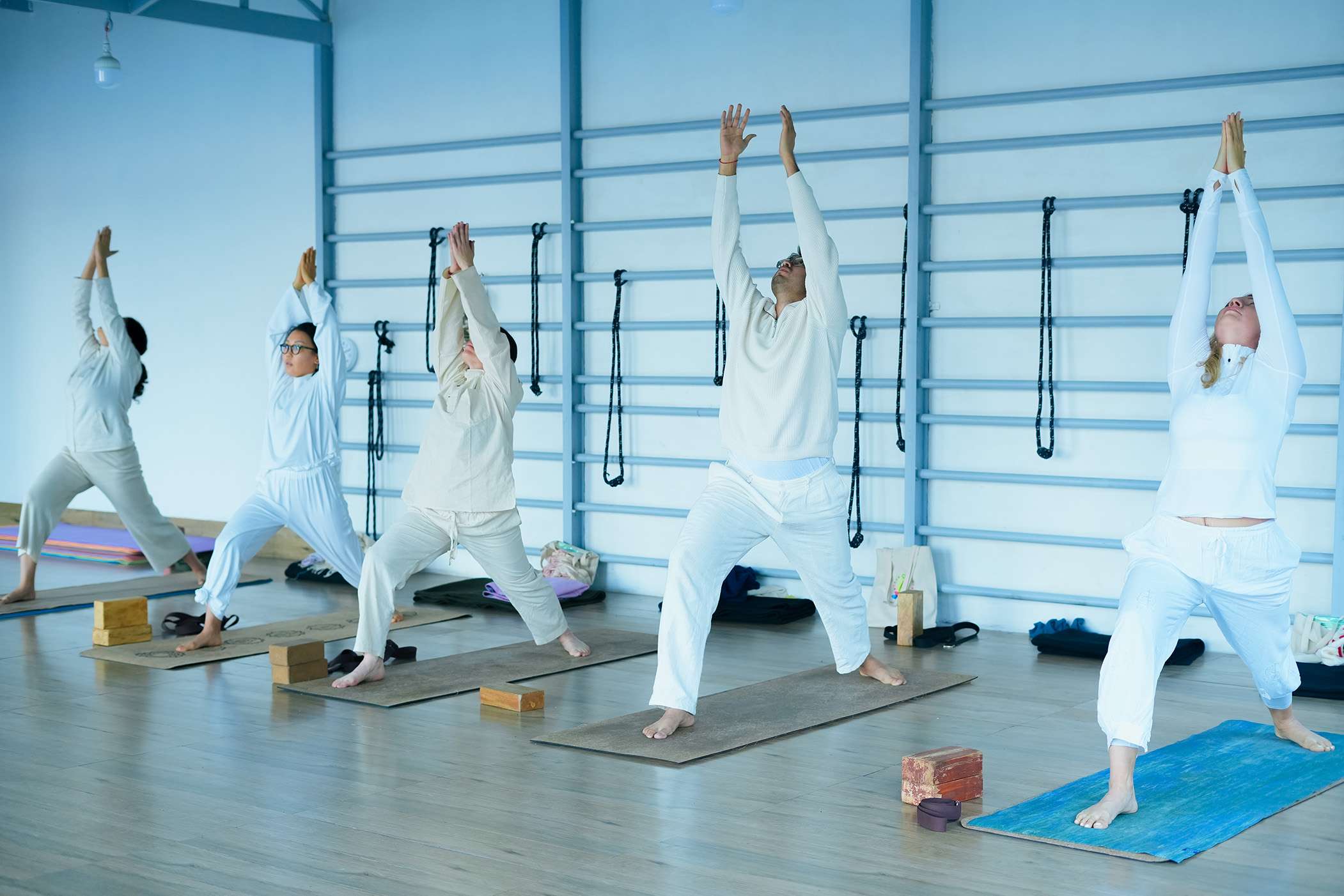
A 200-hour Residential Yoga Teacher Training in Rishikesh delivers the same Yoga Alliance curriculum in person, on a physical campus, over a concentrated residential period — typically 22 to 28 days. Students live at the school, practice together daily, eat together, attend lectures in person, and are immersed in the yogic environment of what is widely considered the world capital of yoga.
Same 200 hours. Same Yoga Alliance certificate at the end. Very different journeys.
1. Cost Comparison
This is often the first question, so let’s answer it directly.
Online YTT — What You Actually Pay
A quality live online 200-hour YTT from an accredited school typically costs between ₹25,000–₹60,000 INR ($300–$750 USD). Tratak Yoga Academy’s online 200-hour program, for instance, is priced at ₹35,000 INR / $450 USD — which includes all live classes, daily recordings, assignments with faculty feedback, and a complimentary YACEP certification on top of the RYT 200 credential.
There are no hidden costs.
- No flights.
- No visa fees.
- No accommodation.
- No change in diet.
You study from home, from your city, from wherever you are.
Residential YTT in Rishikesh — Total Cost of Attendance
A residential 200-hour YTT at a reputable Rishikesh school typically costs between ₹80,000–₹1,80,000 INR ($1,000–$2,200 USD), depending on accommodation type (shared or private), campus, and program inclusions. This generally covers tuition, accommodation, and meals for the full residential period.
What it does not cover is your travel to Rishikesh. Add:
- Return flights (from Europe or USA: $600–$1,400 / from within India: ₹3,000–₹12,000)
- Travel insurance ($50–$150 for a month)
- Visa fees if applicable (for non-Indian students)
- Personal spending during your stay
Realistic total cost for an international student attending a residential YTT in Rishikesh: $2,000–$4,000 USD when you account for travel and incidentals.
The Cost Verdict
Online YTT wins on cost — decisively. For students in India on a budget, or international students for whom travel to India isn’t currently feasible, the online format offers genuine, accredited training at a fraction of the total cost.
That said, the residential experience includes things money doesn’t easily replace — daily immersion, in-person adjustments, community living, and the energy of Rishikesh itself — which we’ll examine further below.
See our full program details and fee breakdown: 200-Hour Online Yoga Teacher Training — Tratak Yoga Academy
2. Time Commitment
Online YTT — Flexible, But Not Effortless
A well-structured online YTT like Tratak’s spreads 200 hours across approximately two months of live Monday-to-Friday classes, with morning and evening sessions covering different modules simultaneously. This means you can remain in your job, manage your family responsibilities, and still make meaningful progress toward certification.
The non-contact hours — assignments, self-practice, self-study — are completed on your own schedule within each module’s timeframe. This requires genuine self-discipline. The flexibility that makes online YTT accessible is also what makes it easier to let slip if life gets busy.
Residential YTT — Concentrated and Non-Negotiable
A residential YTT in Rishikesh typically runs 22–28 days, with a packed daily schedule from 6:00 AM to 9:00 PM. You are physically present, accountable to a group and faculty, and entirely removed from your ordinary life. There is no checking work emails between classes, no domestic distractions, no choice but to be there.
This concentration is both its strength and its limitation. The strength: you accumulate the same 200 hours in under a month, at a depth of daily immersion that simply isn’t replicable at home. The limitation: you need to be able to take three to four weeks entirely away from your work and responsibilities.
The Time Commitment Verdict
Online YTT is more accessible time-wise for working professionals and caregivers. Residential YTT delivers more concentrated transformation per calendar day, but requires a clear window of availability that not everyone has.
3. Flexibility
Online YTT — Study From Anywhere, Anytime (With Structure)
The online format’s biggest practical gift is location independence. A student in Mumbai, Manchester, Melbourne, or Mexico City can attend the same live class. Students who miss a live session receive the recording within 24 hours. Modules are structured but not requiring you to relocate.
This matters enormously for:
- Working professionals who cannot take extended leave
- Parents or caregivers with daily responsibilities
- Students in countries where travel to India requires significant planning
- People exploring yoga teacher training before committing to a residential immersion
Residential YTT — Fixed Location, Immersive Focus
A residential YTT offers no flexibility in terms of location or daily schedule — and that is, in many ways, the point. You are freed from the flexibility of your ordinary life precisely so that you can go deep. The rigidity of the residential schedule — early mornings, back-to-back sessions, community meals — creates a container that flexibility cannot provide.
The Flexibility Verdict
Online wins for flexibility. But it’s worth asking: is more flexibility always better? For personal transformation, a structured container often produces more depth than an open one. Choose flexibility because your life genuinely requires it, not simply because it sounds easier.
4. Learning Experience
This is where the comparison gets more nuanced, and where we think it’s important to be honest.
What Online YTT Does Well
In a high-quality live online program, the theoretical dimensions of yoga education — philosophy, anatomy, teaching methodology, pranayama theory, meditation technique — can be taught to an extremely high standard. A committed online student who attends every live session, completes all assignments, and maintains a dedicated self-practice can develop genuine knowledge and teaching capability.
The best online YTTs use breakout rooms, live feedback, peer teaching practice, and direct Q&A to approximate the interactive experience of in-person learning. These are not nothing. For intellectually rigorous modules like Yoga Anatomy, Yoga Philosophy, and Teaching Methodology, the online format is genuinely effective.
What Residential YTT Offers That Online Cannot Fully Replicate
Hands-on adjustment and physical correction is the clearest gap. In a residential training, a teacher places their hands on your Trikonasana, identifies that your hip alignment is off, and corrects it — in your body, in real time. You feel the difference. That kinesthetic learning is not available online, no matter how sophisticated the video setup.
Beyond adjustments, residential training offers:
Peer learning in real bodies. Watching a classmate struggle with a pose — and working out why, together — teaches observation and adaptability that watching a screen cannot.
24-hour immersion. Conversations over breakfast, informal practice in the evening, questions answered during a walk to the dining hall. The learning doesn’t stop when the scheduled class ends.
The energy of Rishikesh itself. This is difficult to quantify but consistently reported by graduates: there is something specific about studying yoga where yoga has been studied for centuries, on the banks of the Ganga, surrounded by the Himalayas. The environment carries something that contributes to depth of practice.
Experiential understanding of yogic lifestyle. Sattvic diet, early mornings, karma yoga, satsang, pilgrimage to Neelkanth Temple — these are not curriculum line items; they are lived experiences that change a practitioner from the inside in a way that study cannot fully replicate.
The Learning Experience Verdict
For theoretical knowledge and intellectual understanding: online and residential are genuinely comparable, with a quality online program keeping pace well.
For embodied, kinesthetic, and experiential learning: residential training in Rishikesh has a structural advantage that cannot be engineered away by better video technology.
5. Community and Networking
Online Community — Real, But Different
A good online cohort — especially one with live classes and a shared WhatsApp or community group — builds genuine bonds. Students who practice together daily over two months, share their teaching practicum vulnerabilities with each other, and send voice notes in the early morning before Pranayama class develop real connection.
These communities tend to stay active after graduation precisely because they already exist entirely online — there’s no friction to continuing the group chat or scheduling a virtual practice together.
The Rishikesh Community — Forged in Proximity
Sharing a dormitory, eating every meal together, watching each other struggle and succeed through four weeks of intensive training, sitting together on the Ganga bank after Aarti — these experiences form a different quality of bond. Residential YTT graduates routinely cite “the people I met” as among the most transformative aspects of the experience.
These cohorts also form professional networks: international students return to their home countries and teach, and your batchmates become your first global professional community.
The Community Verdict
Online communities are real and lasting. Residential communities are typically deeper and more immediately intensive. If building a strong in-person yoga community is a priority, residential training has the edge.
6. Teaching Practice
Online Teaching Practicum
In an online YTT, teaching practice happens over video — you guide your classmates through a sequence, your faculty observes via screen, and feedback is delivered verbally and in writing. This is genuinely useful practice, particularly for teachers planning to teach online — which, post-2020, is a real and sustainable career.
The limitation is that you cannot physically observe whether your cues are landing in a student’s body. You rely on visual feedback through a camera, which captures perhaps 60% of what an in-person observer would catch.
In-Person Teaching Practicum in Rishikesh
In a residential training, you teach in a room full of real bodies. You must project your voice, navigate the physical space, notice when a student in the back row is hunching and correct them, manage the energy of a group, and hold the room. These are skills that develop specifically through physical practice, and the residential teaching practicum provides them.
The Teaching Practice Verdict
If you plan to teach primarily online, the online practicum prepares you adequately and even gives you a head start. If you plan to teach in person, the residential teaching practicum in Rishikesh is the stronger preparation.
7. Travel and Accommodation Expenses
We covered the numbers in the cost section, but it’s worth considering the travel component independently — because for many students, the question isn’t only financial.
Traveling to Rishikesh means taking time off work, managing visa logistics (for non-Indian students), arranging care for dependents, and disrupting your established routine for four weeks. For many people, this is a feature, not a bug — the disruption is part of the point. For others, it is a genuine barrier that makes online training the only realistic option.
It’s also worth noting: for Indian students, the cost of traveling to Rishikesh from within India is often quite manageable — a train or bus journey rather than an international flight. The travel-cost gap between online and residential is significantly smaller for domestic students than for international ones.
8. Yoga Alliance Recognition
This is the question we’re asked most often, and the answer is simple: both formats are equally recognised by Yoga Alliance USA, provided the school is an accredited Registered Yoga School (RYS).
Yoga Alliance does not distinguish between an RYT 200 earned through a residential program and one earned through a fully online program. The credential on your certificate is identical. What matters is whether the school — not the format — is Yoga Alliance accredited.
Tratak Yoga Academy is a Yoga Alliance USA Registered Yoga School (RYS). Whether you complete our online 200-hour program or our residential Rishikesh training, you graduate with the same Yoga Alliance-recognised 200-hour certificate, and you are eligible to register as an RYT 200 directly with Yoga Alliance.
To understand what RYT 200, E-RYT, and YACEP credentials mean for your teaching career, read: Yoga Alliance Credential Levels Explained — RYT, E-RYT & YACEP
9. Who Should Choose Online YTT?
The online format is likely the better fit if:
You are a working professional who cannot take 3–4 weeks of continuous leave but can commit to daily evening and morning sessions across two months.
You have family responsibilities — children, aging parents, a home — that make extended travel impractical rather than merely inconvenient.
Your budget is genuinely constrained and the all-in cost of a residential program (including travel) would create financial stress rather than investment.
You plan to teach primarily online. If your post-certification teaching career will be virtual — online classes, YouTube content, virtual private sessions — an online practicum gives you direct, relevant experience.
You are in the exploration phase. Online YTT is an excellent way to enter the world of yoga teaching, earn your certification, and decide whether you want to deepen further with a residential 300-hour training or a specialised immersion later.
You live far from India and the combination of international flights, visa, and time away makes a residential training an undertaking that would take months of additional planning.
Ready to explore our online program? Full curriculum and dates here: 200-Hour Online Yoga Teacher Training — Tratak Yoga Academy
10. Who Should Choose the Rishikesh Residential YTT?
The residential format is likely the better fit if:
You are seeking personal transformation, not just certification. If your primary motivation is to change — to go deeper into yourself, to break old patterns, to experience what sustained yogic practice feels like — the residential immersion is structurally designed for this in a way that online training is not.
You can afford a clear 3–4 week window in your life. Students between career phases, recent graduates, people in a transitional life period, or those who have deliberately saved and planned for this experience often get the most from a residential YTT.
You want to teach in person. Physical teaching requires physical practice. The in-person practicum, the live adjustments, the kinesthetic learning — all of these translate more directly into in-person teaching confidence.
You are drawn to Rishikesh and the Himalayan yoga tradition specifically. There are many styles of yoga and many great yoga schools in the world. If classical Hatha, traditional Pranayama, philosophy studied near its source, and the specific energy of the Ganga basin call to you — come.
You value deep, intensive community. If you want to make friends for life through a shared intense experience, the residential cohort model delivers this far more reliably than any online format.
Explore our residential Rishikesh programs: 200-Hour YTT Rishikesh | Silent Forest Yoga Teacher Training
11. The Final Verdict
There is no winner in this comparison in the way that one smartphone wins against another. Online YTT and residential YTT in Rishikesh are tools for different purposes, and the right tool depends entirely on what you’re building.
Choose online if your life requires flexibility, your budget requires lower cost, or you want to begin your teaching journey without a major logistical undertaking. A quality online YTT from an accredited school — with live faculty, real assignments, and a genuine community — is legitimate teacher training, full stop.
Choose Rishikesh if you are ready for immersion, you want the depth and transformation that only physical presence and community living can produce, you plan to teach in person, and you are prepared to invest in the full experience — travel included.
And if you are genuinely uncertain? Consider a sequenced approach: complete the online 200-hour program first, begin teaching, and then — when the timing and resources align — come to Rishikesh for the 300-hour advanced residential training. Many of the world’s most effective teachers have done exactly this: built their certification online, then deepened their practice in person.
Whatever path you choose, choose it with clarity. The quality of your training is ultimately determined not by the format, but by the quality of the school, the faculty, and — most of all — by the commitment you bring to your own practice.
Key Takeaways
- Both online and residential 200-hour YTTs award the same Yoga Alliance RYT 200 credential, provided the school is an accredited RYS. Format does not determine Yoga Alliance recognition — school accreditation does.
- Online YTT is significantly more affordable in total cost, typically $300–$750 USD versus $2,000–$4,000 USD all-in for a residential program including travel.
- Residential YTT in Rishikesh offers advantages that cannot be fully replicated online: physical adjustments, kinesthetic peer learning, 24-hour immersion, and the transformative environment of the world capital of yoga.
- Online YTT suits working professionals, caregivers, budget-conscious students, and those planning to teach online. Residential YTT suits those seeking transformation, in-person teaching preparation, and deep community.
- A sequenced approach — online 200-hour first, then residential 300-hour — is a legitimate and increasingly popular path for aspiring teachers.
- At Tratak Yoga Academy, both formats are delivered by the same experienced Rishikesh faculty with the same Yoga Alliance RYS accreditation, ensuring certification quality in either case.
Frequently Asked Questions
Is an online yoga teacher training certificate valid and recognised by Yoga Alliance?
Yes. Yoga Alliance USA does not differentiate between online and in-person formats when it comes to recognising a 200-hour certificate. What matters is whether the school that conducted the training is a Yoga Alliance Registered Yoga School (RYS). If the school holds RYS accreditation — as Tratak Yoga Academy does — graduates of both online and residential programs are eligible to register as Registered Yoga Teachers (RYT 200) with Yoga Alliance.
How long does a 200-hour online yoga teacher training take to complete?
This varies by program structure. Tratak Yoga Academy’s online 200-hour YTT runs over approximately 11 weeks, from 6 July to 29 September 2026, with live Monday-to-Friday classes and 80 hours of non-contact work (assignments, self-practice, self-study) completed during that period. Some programs offer a more self-paced format spread across 3–6 months.
What is the total cost of a residential 200-hour YTT in Rishikesh including travel?
This varies significantly depending on your point of origin and lifestyle preferences. As a rough guide, the training fee at a reputable Rishikesh school ranges from $1,000 to $2,200 USD (accommodation and meals included). Adding international return flights ($600–$1,400), travel insurance, visa fees, and personal spending, international students should budget $2,000–$4,000 USD in total. Indian students traveling domestically will find the total considerably lower.
Can I learn yoga properly through an online teacher training?
Yes — for the theoretical, philosophical, and breathwork dimensions of yoga, a high-quality live online YTT is fully capable of delivering strong knowledge and skill. The limitation of online training is in hands-on adjustment and embodied, physical peer learning, which require in-person practice to fully develop. Students who complement their online training with a strong personal practice and, where possible, in-person classes with local teachers, typically develop effective teaching skills through the online format.
Which format is better for someone who wants to teach yoga professionally?
Both formats qualify you to teach professionally through Yoga Alliance RYT 200 registration. If you plan to teach in-person classes as your primary format, we recommend supplementing online certification with in-person practice teaching before launching your career — ideally at local studios or community centres. If you plan to teach online, the online practicum prepares you directly. For the deepest preparation for professional in-person teaching, the residential YTT in Rishikesh remains the stronger foundation.
Does Tratak Yoga Academy offer both online and residential 200-hour YTT programs?
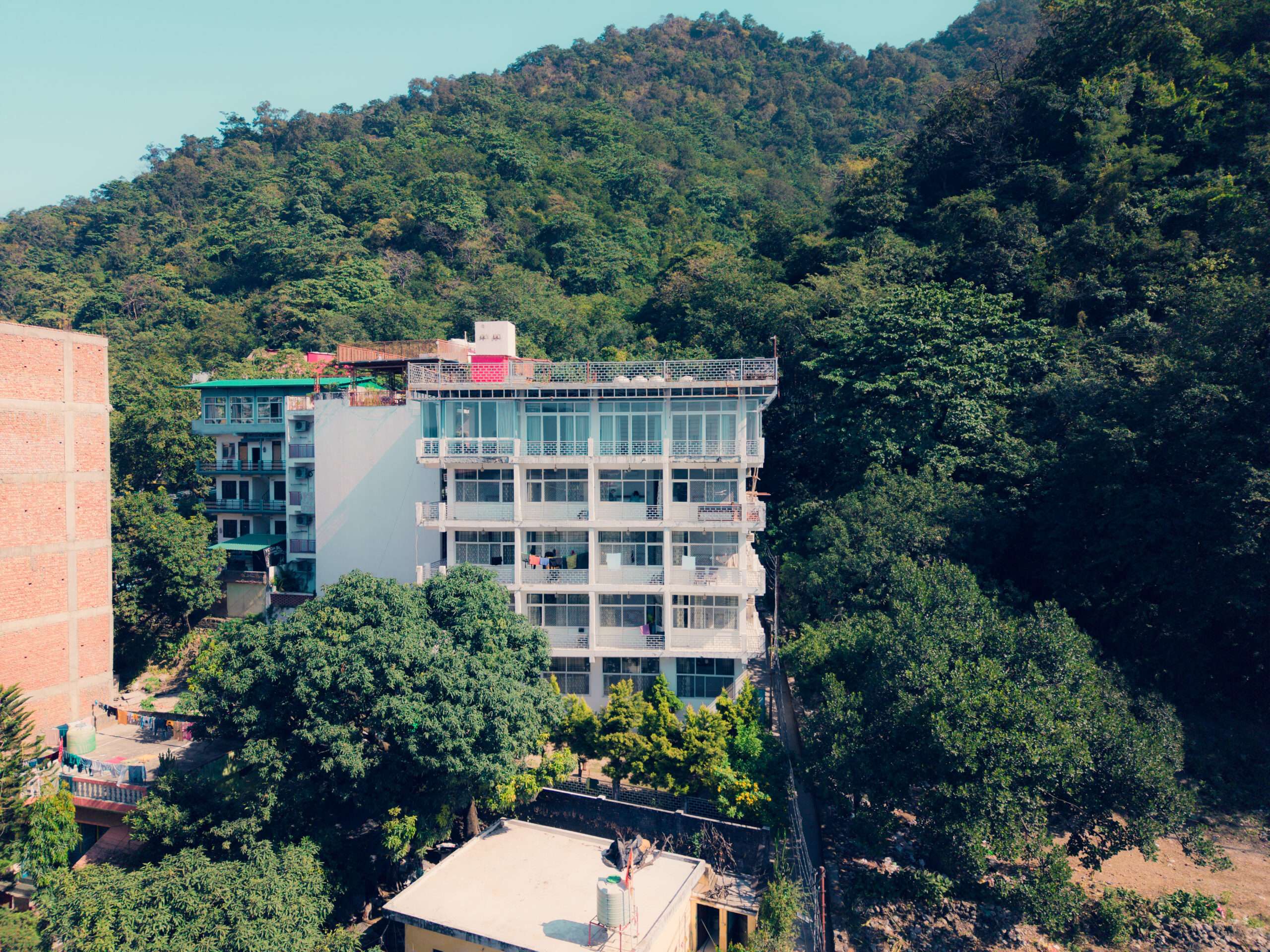
Yes. Tratak Yoga Academy offers a fully live online 200-hour YTT (starting July 2026) and multiple residential YTT programs at our Rishikesh campus, including the Silent Forest Yoga Teacher Training — a 22-day, small-group residential training set in a forest campus near Rishikesh. Both are Yoga Alliance RYS accredited and deliver the same recognised 200-hour certificate.
What is the difference between a live online YTT and a pre-recorded online yoga course?
A live online YTT — like the one offered by Tratak Yoga Academy — involves real-time classes taught by senior faculty, with live interaction, Q&A, feedback on assignments, and peer teaching practice conducted over video. A pre-recorded course is a library of videos you watch at your own pace, with no direct faculty interaction. For Yoga Alliance certification purposes, live interaction and faculty-assessed practicum are important components. Pre-recorded courses vary significantly in quality and Yoga Alliance compliance, so it is essential to verify accreditation before enrolling in any self-paced format.
Is Rishikesh actually important for yoga teacher training, or is it just marketing?
Rishikesh has genuine historical and spiritual significance in the yoga tradition. It is the birthplace of several major yoga lineages, the location where Maharishi Mahesh Yogi brought The Beatles in 1968 (helping introduce yoga to the West), and a living centre of traditional yoga study with ashrams, temples, and teachers that have been active for generations. Students consistently report that studying in Rishikesh carries an energy and authenticity that contributes to the depth of their training experience. Whether that significance is worth the additional cost and travel is a personal decision — but it is not merely marketing.
Can I do the residential YTT in Rishikesh after completing the online 200-hour YTT?
Yes, and this is increasingly common. Many students complete the 200-hour online program first to establish their certification and begin teaching, then come to Rishikesh for the residential 300-hour advanced YTT to deepen their practice significantly. This sequenced approach is a legitimate and effective path to becoming a well-rounded, experienced yoga teacher with both a broad credential base and deep personal practice.
What happens if I miss live classes in an online YTT?
In Tratak Yoga Academy’s online program, all live sessions are recorded and shared with students within 24 hours via the course group. Attendance is tracked, and while missing sessions does not automatically disqualify you, active engagement is assessed throughout the program. Assignment submission for every module is mandatory for certification, regardless of whether you attended the corresponding session live or via recording.
About Tratak Yoga Academy
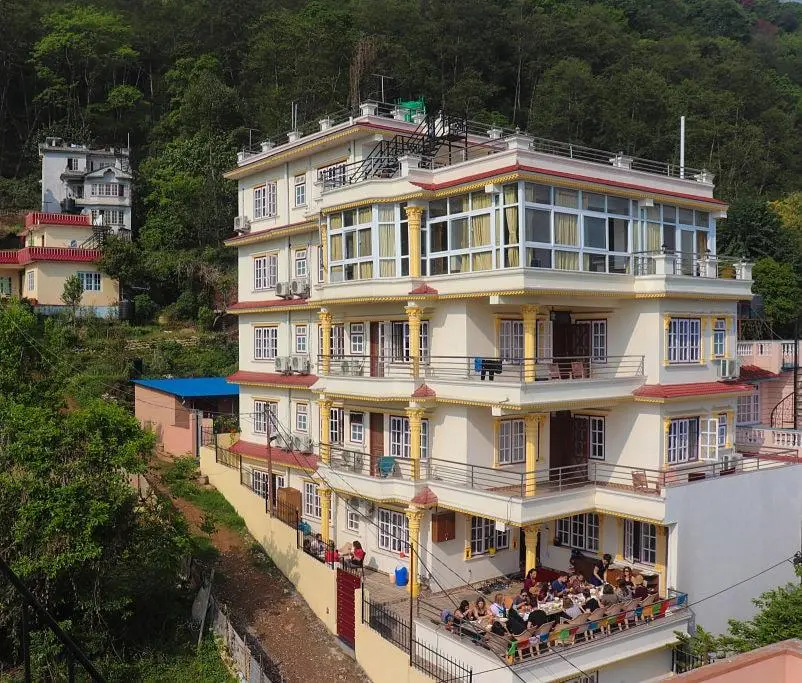
Tratak Yoga Academy is a Yoga Alliance USA-accredited Registered Yoga School (RYS) with physical campuses in Rishikesh, Pokhara, and Bali, and a growing online school reaching students worldwide. Our faculty are experienced Himalayan yoga teachers with deep roots in classical Hatha, Ashtanga, Pranayama, and traditional yogic philosophy.
We offer both residential and online 200-hour and 300-hour YTT programs, specialty certifications in Sound Healing and Prenatal Yoga, and YACEP-eligible continuing education for registered teachers.
🌐 tratakyoga.com 📧 jai.tratak@gmail.com 📸 @tratakyoga


Comments are closed