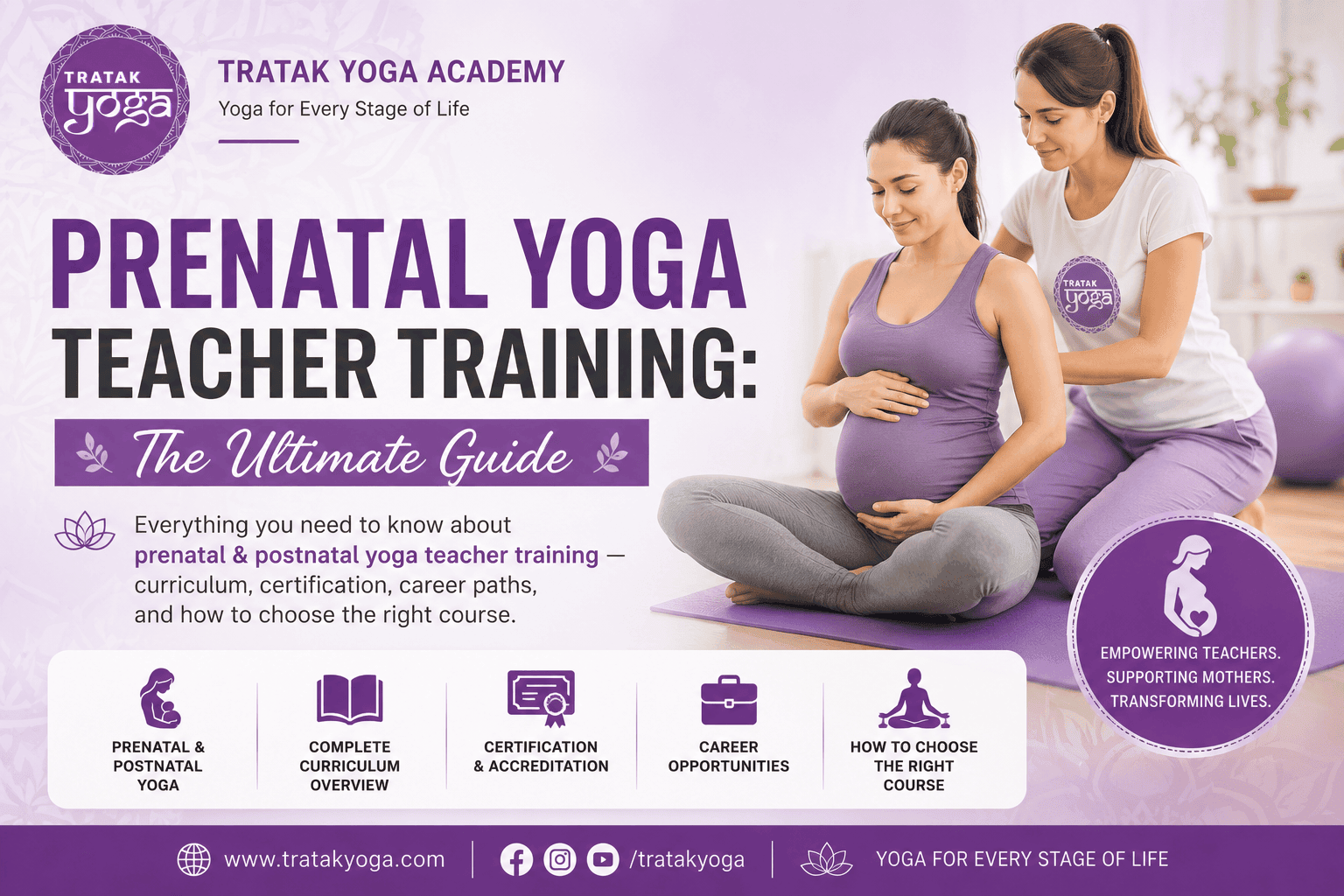
The Ultimate Guide to Prenatal & Postnatal Yoga Teacher Training
Everything an aspiring or practicing yoga teacher needs to know before specializing in one of the fastest-growing, most meaningful niches in the yoga industry — teaching yoga through pregnancy, birth, and beyond.
Key Takeaways
- Prenatal Yoga Teacher Training is a specialized certification that prepares yoga teachers to safely guide students through the physical, hormonal, and emotional changes of pregnancy, birth preparation, and postpartum recovery.
- This is not a “modified vinyasa class” — it requires distinct anatomical knowledge, trimester-specific sequencing, contraindications, and an understanding of the psychology of the perinatal period.
- Most reputable programs run between 85 and 100 training hours, are best pursued after completing a 200-hour foundational YTT, and should carry Yoga Alliance or equivalent accreditation.
- Career paths extend well beyond studio classes — prenatal-postnatal-certified teachers are increasingly hired by hospitals, birthing centers, corporate wellness programs, and private practices.
- Choosing the right course comes down to four factors: accreditation, faculty credentials (ideally including a doula, midwife, or perinatal specialist), depth of postnatal content, and post-certification support.
Introduction: Why Prenatal & Postnatal Yoga Is One of Yoga’s Most Important Specializations
Pregnancy changes a person’s body, breath, and nervous system more dramatically and more rapidly than almost any other life stage — and yet, for decades, prenatal yoga was treated as an afterthought: a “gentle” label slapped onto a regular class with a few poses removed.
That’s changing, and fast. As more expecting parents actively seek out yoga for pain management, birth preparation, and postpartum recovery, studios, hospitals, and wellness centers around the world are looking specifically for teachers who hold a dedicated Prenatal & Postnatal Yoga Teacher Training certification — not just a general 200-hour credential.
This guide is written for two audiences: yoga teachers considering this specialization as a career move, and expecting or postpartum practitioners trying to understand what “certified” actually means when they’re choosing an instructor for one of the most physically vulnerable periods of their life. Whether you’re here to train or to choose a well-trained teacher, understanding what real prenatal-postnatal education involves is the first step.
At Tratak Yoga Academy, prenatal and postnatal training sits alongside our broader Yoga Alliance USA-accredited teacher training ecosystem across Rishikesh, Pokhara, Bali, and our online school — built on the belief that specialized populations deserve specialized, evidence-informed teaching, not generic modifications.
Start with a 200-hour YTT foundation
What Is Prenatal & Postnatal Yoga Teacher Training?
A Definition Beyond “Modified Yoga”
Prenatal and postnatal yoga teacher training is a certification program that equips yoga teachers with the anatomical knowledge, sequencing skills, and communication tools needed to teach yoga safely across three distinct phases:
- Prenatal (pregnancy): first, second, and third trimester-specific practice
- Labor and birth preparation: breathwork, positioning, and pelvic floor awareness
- Postnatal (postpartum): core and pelvic floor rehabilitation, C-section recovery considerations, and the emotional landscape of early parenthood
Why It’s Different From General Yoga Teaching
A general 200-hour YTT teaches you to sequence and cue for a healthy adult body without major structural change happening in real time. Pregnancy is different — a student’s center of gravity, ligament laxity (thanks to the hormone relaxin), cardiovascular demands, and breath mechanics change every few weeks. A teacher without this specific training may unknowingly cue a pose that’s contraindicated in the third trimester, or miss red-flag symptoms that need a referral to a medical provider.
The Core Knowledge Areas Covered
- Trimester-by-trimester anatomical and physiological changes
- Contraindicated poses and safe modifications by trimester
- Pelvic floor anatomy and function (both prenatal and postnatal)
- Diastasis recti — recognition, safe sequencing, and recovery-focused core work
- Breathwork (pranayama) for labor preparation and pain coping
- Postpartum mental health awareness, including recognizing signs of postpartum depression and anxiety
- Scope of practice — knowing precisely when to refer a student to a doctor, physiotherapist, or doula
Who Should Take a Prenatal & Postnatal YTT?
Yoga Teachers Looking to Specialize
If you already hold a 200-hour certification and want to differentiate yourself in a crowded studio market, this is one of the highest-demand niches available. Prenatal-certified teachers are frequently the first specialized hire a studio makes after building out its general schedule.
Doulas, Midwives, and Birth Workers
Many birth professionals pursue this training not to teach full-time yoga classes, but to add movement, breath, and body-awareness tools to their existing client work — creating a genuinely integrated approach to birth support.
Physiotherapists and Postpartum Recovery Specialists
Pelvic floor physiotherapists and postnatal recovery coaches often add this certification to bridge clinical rehabilitation with a movement-based practice their clients can sustain long-term.
Yoga Practitioners Who Are Pregnant or Postpartum Themselves
It’s common — and genuinely valuable — for teachers to pursue this training during their own pregnancy or postpartum period, when the embodied, lived understanding of the changes involved becomes part of their teaching credibility.
Prerequisites: What You Need Before Starting
Most reputable programs, including specialized prenatal-postnatal tracks, require:
- A completed 200-hour Yoga Teacher Training (Yoga Alliance registered or equivalent)
- Basic understanding of anatomy and physiology (a program may offer a refresher module)
- Some programs prefer, but don’t always require, prior teaching experience
Do You Need to Be a Parent Yourself?
No. While lived experience of pregnancy or birth can deepen empathy and intuition in teaching, it is not a prerequisite. What matters far more is rigorous anatomical training and the humility to constantly defer to each student’s individual medical guidance.
Explore our 85 hours Prenatal & Postnatal YTT program
Curriculum Breakdown: What a Comprehensive Program Should Cover
A well-structured Prenatal & Postnatal YTT should move systematically through pregnancy, birth, and recovery rather than treating them as a single blended topic. We cover following modules:
1: Yogic Wisdom for Pregnancy
- Garbha Samskara
- Garbha Samvaad
- Garbha Shuddhi
- Brain-stimulating activities for fetus
- Role of Raagas in pregnancy
- Mantra Chanting (20 selected prenatal mantras – practical use)
2: Anatomy, Physiology & Medical Awareness
- Understanding the female reproductive system
- Menstrual cycle (hormonal & yogic view)
- Thyroid & pregnancy
- Hormonal imbalance & fertility
- Anatomy & physiology of pregnancy
- Embryology & fetal development
- Anatomy & physiology of childbirth
3: Emotional & Mental Well-Being
- Stress during pregnancy
- Emotional Freedom Technique (EFT)
- Body Blessed Technique
- Grounding techniques
- Guided pregnancy meditations (15 practices)
4: Prenatal Yoga Asana Practices
- Guidelines for prenatal yoga practice
- Trimester-wise yoga asanas
- Pregnancy postures (80 safe postures)
- Chair yoga for pregnancy
- Ball yoga for pregnancy
- Pillow & prop-based practices
- Vinyasa flow styles (3 safe variations)
- Postures to support a healthy pregnancy
5: Pranayama, Mudra & Therapeutic Tools
- Pranayama & breathing techniques (18 techniques)
- Mudra therapy (30 pregnancy-safe mudras)
- Yoga therapy for common prenatal problems
- High-risk pregnancy case scenarios (what to do & what to avoid)
6: Teaching Methodology
- Teaching prenatal yoga safely
- Class sequencing & cueing
- Language, touch & consent
- Ethics & responsibility of a prenatal yoga teacher
7: Postnatal Yoga – Theory & Practice
- Postnatal recovery theory
- Postnatal yoga practices
- Core restoration after delivery
8: Diastasis Recti
- Diastasis recti theory
- Corrective yoga practices
- Contraindications & safety
9: Fertility & Therapeutic Understanding
- Fertility yoga concepts
- Yoga for hormonal balance
- Case-study reading (PCOS, PCOD, thyroid, stress-related infertility)
10: Diet & Nutrition (FREE MODULE)
- Yogic diet during pregnancy
- Trimester-wise nutrition awareness
- Postnatal nourishment principles
11: Self-Study & Reflection
- Practice observation
- Reflective journaling
- Short written assignments
- Class planning project
Sub-Module — Mental and Emotional Health in the Postnatal Period
A responsible program will dedicate real time to the emotional realities of the fourth trimester — including recognizing signs of postpartum depression and anxiety, and understanding a teacher’s role (support and referral, never diagnosis or treatment).
How Many Hours Should a Prenatal & Postnatal YTT Be?
There’s real variation in the market, and it matters. A weekend workshop labeled “prenatal certification” is not the same as a structured training.
- 20–30 hours: Introductory-level; useful as a first exposure, but generally not sufficient to teach independently with full confidence
- 50–85 hours: The most common range for a genuinely comprehensive program covering all five modules above in depth
- 95+ hours: Extended programs, often including supervised teaching practice and case-study work
Tratak Yoga Academy’s own Prenatal & Postnatal Yoga Teacher Training is built as an 85-hour program specifically because that depth is what’s needed to move a teacher from “aware of modifications” to genuinely competent across the full prenatal-to-postnatal arc — anatomy, sequencing, breathwork, and postnatal recovery, without cutting corners on any one phase.
Certification & Accreditation: What Actually Matters
Yoga Alliance RPYT (Registered prenatal Yoga Teacher) Recognition
Look for programs registered as Yoga Alliance, which signals the curriculum has met a recognized minimum standard for content and instructor qualification.
Instructor Credentials
Ask who is actually teaching the anatomy and physiology modules. The strongest programs bring in guest faculty with clinical or birth-work credentials — a doula, midwife, or pelvic floor physiotherapist — rather than relying solely on a yoga teacher’s general knowledge.
Red Flags to Watch For
- No mention of contraindications or scope-of-practice training
- Postnatal content squeezed into a single short module (or missing entirely)
- No anatomy and physiology component beyond “avoid deep twists”
- No information on how graduates are supported after certification
Understanding yoga teacher accreditation
Career Paths After Certification
Studio and Independent Teaching
The most common path — teaching dedicated prenatal, postnatal, or “mama and baby” classes at a yoga studio or independently, either in-person or online.
Hospital and Birthing Center Programs
A growing number of hospitals and birthing centers now offer prenatal yoga as part of integrative maternity care, creating opportunities for certified teachers to work alongside clinical staff.
Corporate and Insurance-Linked Wellness Programs
Some corporate wellness providers and health insurance wellness programs have started including prenatal yoga as a covered or subsidized benefit — an emerging but growing income stream for specialized teachers.
Private and One-on-One Client Work
Because pregnancy is such an individualized experience, many prenatal-postnatal teachers build a significant part of their practice around private sessions — particularly for high-risk pregnancies or clients recovering from complicated births, where a group class setting isn’t appropriate.
How to Choose the Right Prenatal & Postnatal YTT Program
Use this checklist when comparing programs:
- Is it Yoga Alliance registered or recognized for Continuing Education credit?
- Does the curriculum cover postnatal recovery in genuine depth — not just pregnancy?
- Who teaches the anatomy modules — is there clinical or birth-work expertise involved?
- Does the program include supervised or practice teaching, not just theory?
- Is there a clear referral framework taught — knowing when not to teach a pose or class?
- What kind of post-certification support (community, mentorship, job leads) is offered?
- Does the program format (online, in-person, or hybrid) fit realistically into your schedule and learning style?
Online vs. In-Person Prenatal & Postnatal Training
The Case for Online Training
Online programs offer flexibility that matters enormously for this specific audience — many people pursuing prenatal-postnatal certification are themselves parents, or working teachers fitting training around existing class schedules. Anatomy and theory content, in particular, translates well to an online format.
The Case for In-Person Training
Hands-on assisting techniques — a crucial skill in prenatal teaching, where physical adjustments must account for joint laxity and changing balance — are learned far more effectively in person, with real-time feedback from experienced faculty.
The Hybrid Middle Ground
Many programs now combine online theory modules with an in-person intensive for practical teaching and assisting — often the most practical option for working teachers balancing this specialization against existing commitments.
Choosing between online and in-person training
Common Myths About Prenatal & Postnatal Yoga Teaching
Myth: “Prenatal yoga is just gentle yoga.” Reality: it requires distinct anatomical knowledge and sequencing logic specific to a rapidly changing body — not simply a slower pace or fewer poses.
Myth: “You can’t teach prenatal yoga unless you’ve been pregnant.” Reality: rigorous training and scope-of-practice awareness matter far more than personal experience, though lived experience can add depth to teaching.
Myth: “Postnatal yoga is just prenatal yoga in reverse.” Reality: postpartum recovery — diastasis recti, pelvic floor rehabilitation, C-section healing — requires entirely separate knowledge from pregnancy-focused teaching, which is why comprehensive programs treat it as its own module, not an appendix.
Myth: “Any yoga teacher can safely lead a mixed-trimester prenatal class.” Reality: without specific training, a teacher may not recognize which poses are inappropriate for a student in her third trimester versus her first, within the very same room.
Frequently Asked Questions
What is prenatal yoga teacher training?
Prenatal yoga teacher training is a specialized certification that teaches yoga instructors the anatomy, physiology, sequencing, and safety considerations required to teach yoga to pregnant students across all three trimesters, as well as during postpartum recovery.
Do I need a 200-hour YTT before taking a prenatal yoga certification?
Yes, in almost all reputable programs. A prenatal-postnatal training is a specialization built on top of foundational teaching skills, not a replacement for them.
How long does prenatal yoga teacher training take to complete?
Program length varies from short introductory workshops (20–30 hours) to comprehensive certifications (50–95 hours). A comprehensive program covering both prenatal and postnatal content in depth typically falls in the 50 to 95-hour range.
Can I complete prenatal yoga teacher training online?
Yes. Many programs, including hybrid formats, deliver anatomy, physiology, and sequencing theory online, while reserving hands-on assisting practice for an in-person or live virtual component.
Is prenatal yoga teacher training only for people who want to teach pregnant clients?
No. Doulas, midwives, pelvic floor physiotherapists, and postpartum recovery specialists frequently pursue this training to add movement and breathwork tools to their existing client work.
What’s the difference between prenatal and postnatal yoga training?
Prenatal training focuses on pregnancy-specific anatomy, trimester-based sequencing, and birth preparation. Postnatal training focuses on postpartum recovery — including diastasis recti, pelvic floor rehabilitation, and C-section healing considerations. A comprehensive program covers both as distinct, in-depth modules.
How much can a certified prenatal yoga teacher earn?
Earnings vary widely by location, format (group classes vs. private sessions), and experience, and depend heavily on local market rates — private prenatal sessions generally command a premium over group class rates due to the specialized, individualized nature of the work.
A Note From Tratak Yoga Academy
Teaching through pregnancy and postpartum is a genuine responsibility — one that asks more of a teacher than enthusiasm and good intentions. It asks for real anatomical literacy, humility about scope of practice, and a willingness to say “please check with your doctor” as often as it’s needed. As a Yoga Alliance USA-accredited school with campuses in Rishikesh, Pokhara, and Bali and a dedicated online program, we built our Prenatal & Postnatal Yoga Teacher Training around that responsibility — not as an add-on credential, but as a depth-first specialization for teachers who want to do this work well.
This article is for educational purposes. Prenatal and postnatal yoga teacher training does not qualify graduates to provide medical advice; students and teachers should always defer to qualified healthcare providers for individual medical guidance.