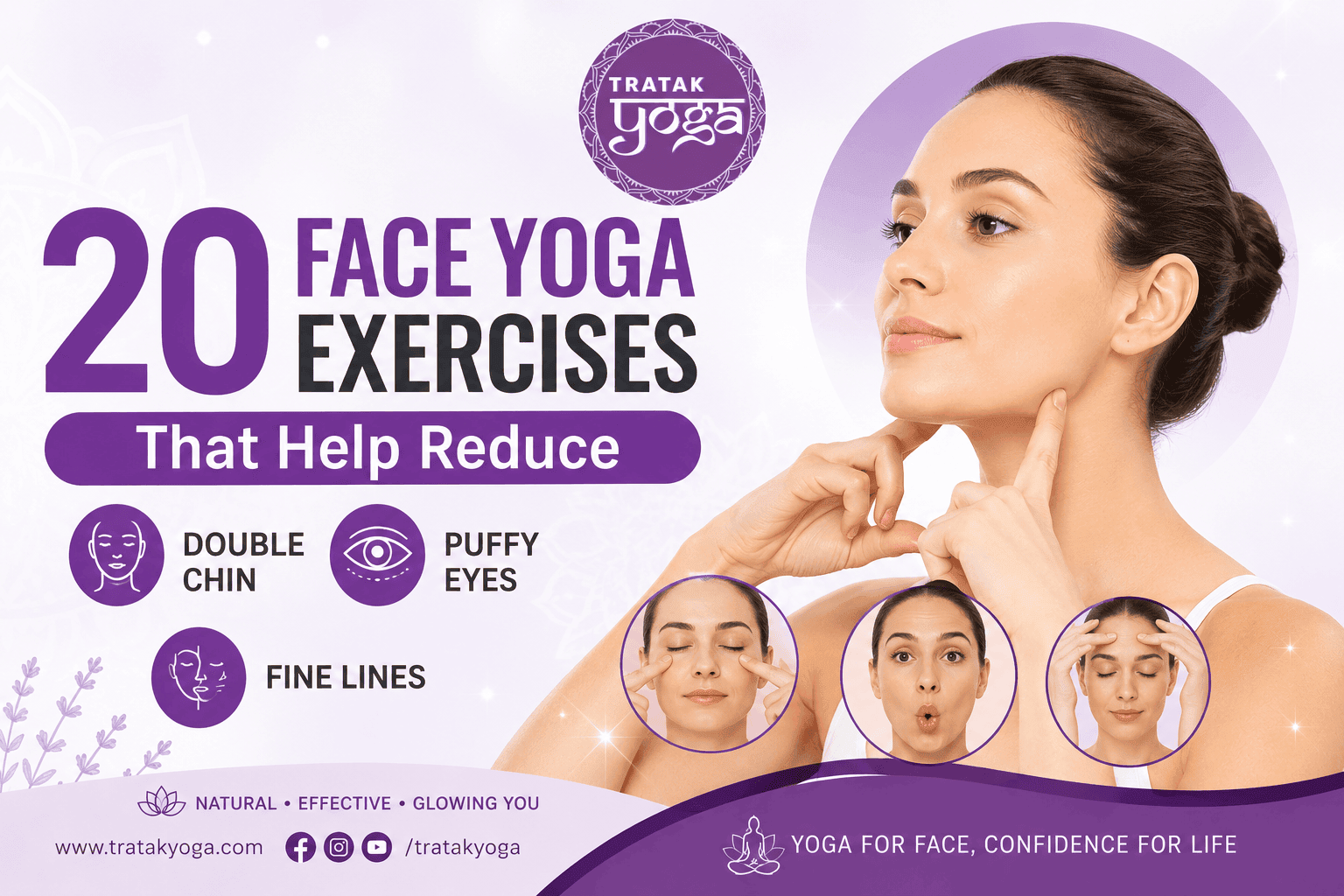
20 Face Yoga Exercises That Help Reduce Double Chin, Puffy Eyes & Fine Lines
Medically-informed, yoga-tradition-rooted facial exercises you can practice in 15 minutes a day — no needles, no creams, just breath, mudra, and mindful movement.
Key Takeaways
- Face yoga uses targeted muscle contractions, massage, and breathwork to tone the 40+ muscles in your face, which can improve circulation, lymphatic drainage, and skin firmness over consistent practice.
- These 20 exercises specifically target three common concerns: double chin (jawline sagging), under-eye puffiness, and fine lines around the forehead, eyes, and mouth.
- Consistency matters more than intensity — most practitioners notice visible changes in skin tone and facial definition within 4 to 8 weeks of daily practice.
- Face yoga is a complementary practice, not a medical treatment; it works best alongside good hydration, sleep, sun protection, and a balanced diet.
- This routine draws on classical yogic facial techniques (like Simhasana and Bhastrika-based facial breathing) combined with modern facial-fitness science, reflecting Tratak Yoga Academy’s approach to holistic, tradition-rooted wellness education.
Introduction: Why Your Face Deserves a Yoga Practice Too
We spend hours perfecting our downward dog and refining our alignment in Warrior II, yet most of us never think to bring the same mindful attention to the 40-plus muscles sitting right beneath our skin — the ones responsible for every smile, frown, and raised eyebrow we’ve made since childhood.
Face yoga is exactly what it sounds like: a system of exercises, massage techniques, and breathwork designed to tone, lift, and relax the muscles of the face and neck. Just like the muscles in your arms or core, facial muscles can lose tone with age, stress, poor posture, and gravity. The result? A softened jawline, puffiness around the eyes, and the gradual etching of fine lines.
At Tratak Yoga Academy, where we train yoga teachers across our Rishikesh, Pokhara, Bali, and online campuses, we’re often asked whether “real” yoga has anything to say about facial aging. The answer is yes — yogic tradition has long recognized the face as an extension of the body’s energetic and muscular system. Practices like Simhasana (Lion’s Pose), facial bandhas (locks), and pranayama-linked facial relaxation techniques have quietly informed what the modern wellness world now markets as “face yoga.”
This guide brings together 20 exercises, organized around three of the most common concerns people search for: a double chin, puffy eyes, and fine lines. Each exercise includes clear instructions, the muscles it targets, and how often to practice it.
How Face Yoga Works: The Science and the Tradition
Before diving into the exercises, it helps to understand why moving your face intentionally can make a visible difference.
The Muscular Case
Your face has more muscles per square inch than almost any other part of your body — muscles that control expression, chewing, and eye movement. Like any muscle group, they respond to resistance training. Repeated, deliberate contraction and release can improve muscle tone, which in turn can create a subtly firmer, more lifted appearance over time.
The Circulatory and Lymphatic Case
Many face yoga movements double as gentle massage. This encourages blood flow and helps move lymphatic fluid — the fluid responsible for that puffy, swollen look under the eyes, especially in the morning. Better lymphatic drainage is one of the most well-supported benefits of facial massage-based practices.
The Yogic Case
In yogic philosophy, the face is never treated as separate from the body’s larger energetic system. Tension held in the jaw, brow, and eyes is considered a reflection of tension held in the mind (chitta). Practices like Simhasana were traditionally used not for “anti-aging,” but to release tension in the throat and face and to stimulate the Vishuddha (throat) chakra. The cosmetic benefits are, in many ways, a welcome side effect of a much older intention: releasing stored tension and improving prana (life-force) flow through the upper body.
Before You Begin: Preparation Tips
- Cleanse your face and tie back your hair.
- Sit or stand tall, spine long, shoulders relaxed — posture affects facial tension more than people realize.
- Warm your hands by rubbing your palms together before any massage-based exercise.
- Breathe consciously throughout — most exercises pair a movement with an inhale or exhale.
- Use a mirror, especially when starting out, to check you’re engaging the right muscles rather than straining your neck or squinting.
- Go slow. Face yoga is about controlled, deliberate movement, not rapid repetition.
7 Face Yoga Exercises to Help Reduce a Double Chin
A double chin is often less about weight and more about weak platysma (neck) and jaw muscles combined with poor posture — especially “tech neck” from looking down at phones and laptops for hours.
1. The Chin Lift (Neck Stretch Pose)
Tilt your head back to face the ceiling, keeping your lips closed. Push your lower jaw forward as if trying to kiss the sky, hold for 5–10 seconds, then release. This stretches and engages the platysma muscle along the jawline and upper neck.
Repeat: 10 times, twice daily.
2. Neck Roll with Resistance
Slowly roll your head in a full circle, pausing at the point where your chin is closest to your chest to gently press your tongue to the roof of your mouth. This engages the deep neck flexors that support jawline definition.
Repeat: 5 rolls each direction.
3. The “O” and Chin Press
Open your mouth into an exaggerated “O” shape, then curl your lower lip over your bottom teeth. Gently press your chin upward with your index finger while trying to open your mouth further against the resistance.
Repeat: 10 times.
4. Tongue-to-Roof Jaw Lift
Press your tongue firmly to the roof of your mouth and hum or hold for 10 seconds while keeping your jaw relaxed. This is one of the most effective isometric exercises for tightening the area directly under the chin.
Repeat: 10 reps.
4 b. Jaw Release Sub-Technique: Side-to-Side Jaw Glide
Keeping lips closed, slowly glide your lower jaw side to side, 10 times each direction, to engage the masseter and platysma without straining the temporomandibular joint (TMJ). Skip this if you have existing jaw/TMJ issues.
5. The Platysma Squeeze (Simhasana-Inspired Roar)
Rooted in Lion’s Pose, this exercise involves opening your mouth wide, sticking your tongue out and down toward your chin, and exhaling forcefully with a “haa” sound while widening your eyes. This activates the platysma muscle along the entire jaw and neck line, and is one of the oldest yogic facial exercises on record.
Repeat: 5–7 rounds.
6. Chin-to-Chest Nod with Breath
Inhale as you lift your chin toward the ceiling; exhale as you slowly lower it to your chest, feeling a stretch along the entire front of your neck. This combines a gentle stretch with breath awareness, echoing the slow, breath-linked movement quality of asana practice.
Repeat: 8 rounds.
7. Collarbone Backward Head Tilt
Tilt your head back so you’re looking at the ceiling, then turn your face slightly to one side and place two fingers just above your collarbone, applying gentle downward pressure while you attempt to lower your chin against the resistance. Switch sides.
Repeat: 5 times per side.
7 Face Yoga Exercises for Puffy Eyes
Puffiness under the eyes is usually caused by fluid retention, poor sleep, allergies, or sluggish lymphatic drainage — and gentle massage-based movement can meaningfully help move that fluid along.
8. Orbital Bone Tapping (Lymphatic Drainage Tap)
Using your ring fingers (they apply the lightest pressure naturally), gently tap along the bony orbit of your eye socket — starting at the inner corner, moving along the brow bone, and back under the eye to the inner corner again. This stimulates lymphatic flow in the delicate under-eye area.
Repeat: 15–20 taps per circuit, 2 circuits.
9. The Eye Squeeze and Release
Close your eyes gently, then squeeze your eyelids tightly shut for 5 seconds, and release completely. This activates the orbicularis oculi muscle, the ring muscle surrounding the eye responsible for firmness in the under-eye area.
Repeat: 10 times.
10. Wide-Eye Hold
Open your eyes as wide as possible without raising your eyebrows (use your fingers to gently hold your brows down if needed), hold for 5 seconds, then relax. This isolates and strengthens the eye muscles independently of the forehead.
Repeat: 8–10 reps.
11. Under-Eye Lymphatic Sweep
Using your index fingers, sweep gently from the inner corner of your under-eye outward toward your temple, then continue down toward your ear and neck — mimicking the natural direction of lymphatic drainage. This is one of the single most effective techniques for reducing morning puffiness.
Repeat: 10 sweeps per side.
12. The Peace-Finger Eye Press
Make a “peace sign” with your index and middle fingers. Place them at the outer corners of your eyes and gently press outward while attempting to squint. This resists crow’s-feet formation while also toning the muscle responsible for under-eye tension.
Repeat: 10 times.
13. Cold Water Splash and Sitali Pranayama Pairing
Splash cool water on closed eyes, then follow with 5–8 rounds of Sitali Pranayama (cooling breath — inhale through a curled tongue or pursed lips, exhale through the nose). The cooling breath is traditionally used to reduce internal heat and, anecdotally, pairs well with reducing visible puffiness and eye strain.
14. Palming (Netra Shanti / Eye Relaxation)
Rub your palms together vigorously until warm, then gently cup them over your closed eyes without pressing on the eyeballs. Hold for 30–60 seconds, breathing slowly. Borrowed directly from yogic eye-care practices (Netra Vyayam), palming relaxes the eye muscles and reduces the strain that contributes to puffiness and dark circles over time.
6 Face Yoga Exercises for Fine Lines
Fine lines typically form first around the eyes (crow’s feet), forehead, and mouth (nasolabial folds) — areas of repeated, unconscious muscle movement.
15. The V Fingers Forehead Smoother
Place your index fingers in a V shape on your forehead, gently pressing the skin down and outward while you try to raise your eyebrows against the resistance. This strengthens the frontalis muscle without deepening forehead lines.
Repeat: 10 reps.
16. Cheek Lifter (The Smile Press)
Smile with your mouth closed, then place your fingertips lightly on the top of your cheeks and push up while trying to smile wider against the resistance. This lifts the cheek muscles that support the nasolabial fold area.
Repeat: 10 times.
17. Surprised Face Hold
Raise your eyebrows as high as possible while opening your mouth into a soft “O,” holding the stretch across your whole face for 5 seconds. This engages both the forehead and the mid-face simultaneously.
Repeat: 8 reps.
18. Puffed Cheek Air Transfer
Fill both cheeks with air, then push the air from one cheek to the other, back and forth, 10 times. This works the buccinator and surrounding cheek muscles that soften and hollow with age.
19. The Fish Face (Mouth Corner Toner)
Suck in your cheeks to create a “fish face,” and hold for 5–10 seconds while trying to smile. This targets the muscles around the mouth that contribute to smile lines and marionette lines.
Repeat: 8–10 reps.
20. Bhramari-Linked Lip and Jaw Release
Close your lips and hum gently (as in Bhramari Pranayama — the humming bee breath), feeling the vibration around your mouth, jaw, and sinuses. Beyond its known calming effect on the nervous system, the gentle internal vibration is believed to relax facial tension patterns that contribute to lines forming around the mouth.
Repeat: 5–7 rounds.
Sample 15-Minute Daily Face Yoga Routine
Time | Focus | Exercises |
|---|---|---|
0–4 min | Warm-up & Jawline | Chin Lift, Simhasana Roar, Tongue-to-Roof Lift |
4–8 min | Eyes & Puffiness | Orbital Tapping, Under-Eye Sweep, Palming |
8–12 min | Fine Lines | Cheek Lifter, Fish Face, V Fingers Smoother |
12–15 min | Cool Down | Bhramari Humming, Sitali Pranayama, Palming |
Practice this sequence in the morning to reduce overnight puffiness, or in the evening as a way to release the day’s accumulated facial tension.
How Long Until You See Results?
Most people who practice consistently — 10 to 15 minutes, 5 to 6 days a week — begin noticing subtle changes in skin tone and jawline definition around the 4-week mark, with more visible results by 8 to 12 weeks. Like any physical practice, face yoga rewards consistency over intensity. Skipping a few days occasionally won’t undo your progress, but sporadic practice (once a week or less) is unlikely to produce noticeable change.
It’s worth setting realistic expectations: face yoga tones existing muscle and improves circulation, but it is not a substitute for medical or dermatological treatment where those are appropriate, and it will not reverse significant skin laxity caused by major volume loss. Think of it the way you’d think of a home workout for your face — supportive, cumulative, and most effective when combined with good sleep, hydration, sun protection, and stress management.
Common Mistakes to Avoid
- Overdoing intensity — face yoga should never cause pain or leave your skin red for hours; that suggests you’re pulling too hard rather than engaging the muscle.
- Skipping the breath — the breath component isn’t decorative; it’s part of what makes these exercises “yoga” rather than isolated gym-style facial reps.
- Practicing on dry, unmoisturized skin — this can cause unnecessary friction during massage-based exercises; a light natural oil (like jojoba or rosehip) can help.
- Expecting overnight results — as with any yoga practice, the benefits compound with time, not with a single intense session.
- Ignoring posture — a forward head position undoes much of the jawline work described above; pair this practice with general postural awareness throughout the day.
Frequently Asked Questions
Does face yoga really work for a double chin?
Face yoga can help tone the platysma and jaw-supporting muscles, which may improve the visible firmness of the jawline over consistent practice. It’s most effective for muscle-related sagging and mild-to-moderate cases; it won’t address a double chin caused primarily by excess fat deposits or significant skin laxity.
How often should I do face yoga exercises?
For visible results, most practitioners recommend practicing 10 to 15 minutes daily, or at minimum 5 to 6 times per week, for 8 to 12 weeks before evaluating results.
Can face yoga get rid of puffy eyes permanently?
Face yoga can meaningfully reduce puffiness caused by fluid retention and poor lymphatic drainage through massage-based techniques. However, puffiness caused by allergies, sleep habits, or genetics may require additional lifestyle changes alongside the practice.
Is face yoga safe for sensitive or aging skin?
Yes, when practiced gently. Avoid aggressive pulling or stretching of the skin, always work with clean hands, and stop any exercise that causes discomfort. Those with active skin conditions, recent facial procedures, or TMJ disorders should consult a doctor before beginning.
What is the difference between face yoga and facial massage?
Facial massage typically focuses on relaxation and circulation through passive touch, while face yoga combines active muscle contractions (isometric exercises), massage, and breathwork — making it a more complete, muscle-engaging practice rooted in yogic tradition.
Can men practice face yoga too?
Absolutely. Facial muscle tone, circulation, and tension release benefit anyone regardless of gender. Many of the exercises above, particularly the jawline and neck exercises, are equally relevant for men.
Do I need any equipment for face yoga?
No equipment is required — just clean hands, a mirror (optional, mainly for beginners), and a few minutes of quiet, focused time.
A Note From Tratak Yoga Academy
Face yoga sits at a meaningful intersection: it’s approachable enough for a complete beginner to start today, yet it’s rooted in genuine yogic techniques — Simhasana, Bhramari, Sitali, and Netra Vyayam — that have been part of yogic self-care for centuries. As a Yoga Alliance USA-accredited school with campuses in Rishikesh, Pokhara, and Bali, we believe the same principles that guide a strong asana or pranayama practice — consistency, breath awareness, and non-strain — apply just as much to the muscles of your face as they do to the rest of your body.
This article is for educational purposes and reflects general facial exercise practices. It is not a substitute for professional dermatological or medical advice.