

Most people believe that yoga teacher training is just about knowing all those amazing postures. That is not the case. Every successful teacher comes from weeks of learning about anatomy, philosophy, breath, and teaching.
If you plan to join a course, you should know the 200-Hour Yoga Teacher Training Curriculum before you pay a single rupee. This blog explains the Subjects Covered in a 200-Hour Yoga Teacher Training Course, how many hours each one takes, and what you will actually learn, so nothing surprises you on day one. Let’s get started without any delay!
1. Techniques, Training, and Practice (Asana & Movement) (Approx. 100+ Hours)
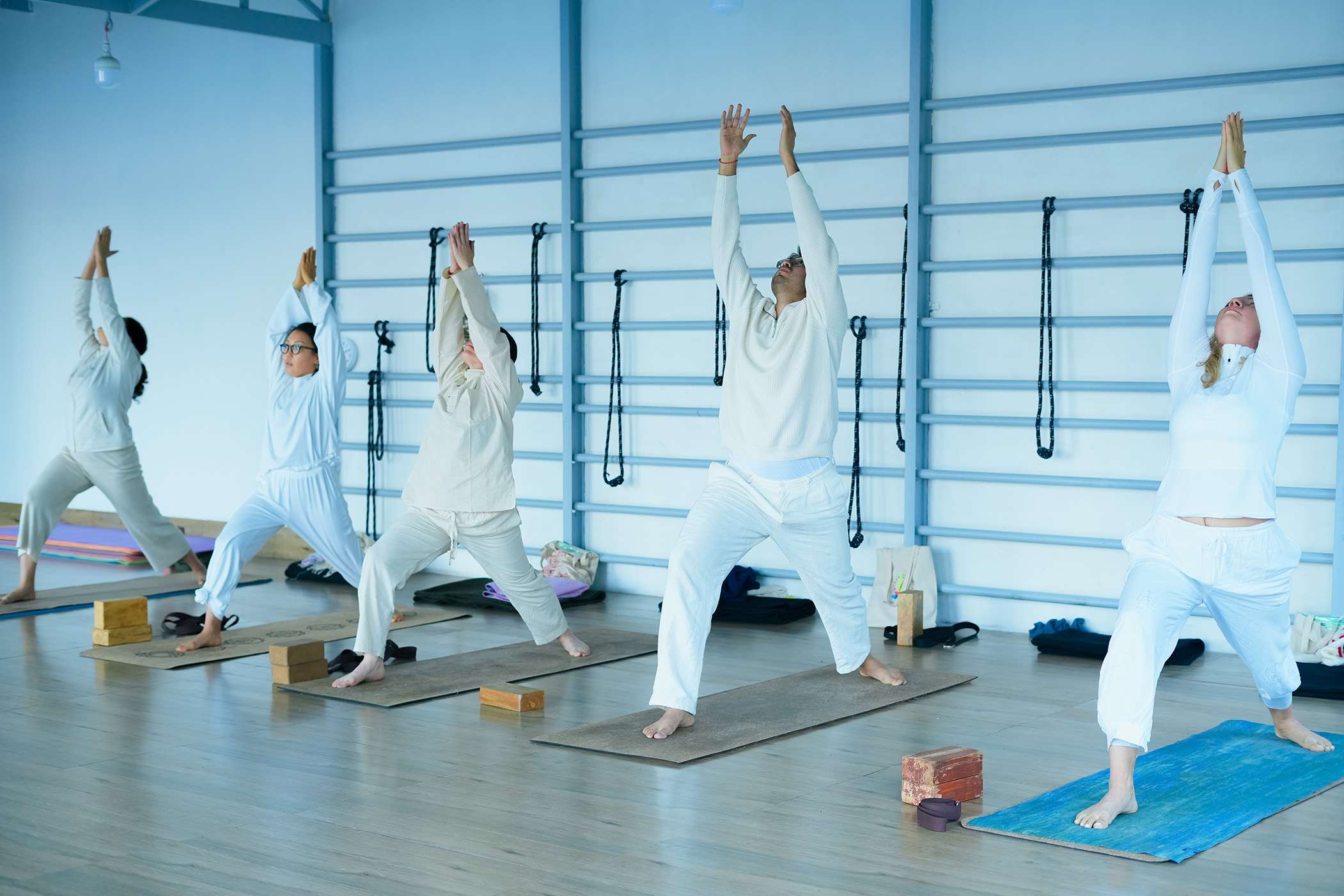
This is the heart of the 200-Hour Yoga Teacher Training Curriculum. You spend most of your time on the mat, learning postures, breathing, meditation, and cleansing practices. Expect around 100 or more hours here, because you cannot teach what you have not practised yourself.
Asanas (Postures): You learn the main posture families, each studied for its benefits and common mistakes.
- Standing and balancing poses
- Forward bends, backbends, and twists
- Inversions and restorative poses
Alignment and Adjustment: You learn how each pose should look and feel in different bodies. Teachers also practise safe, hands-on adjustments and use props like blocks and straps, so students with stiff or injured bodies can still practise comfortably.
Pranayama & Breathwork: Breath control is taught step by step, starting with simple awareness. Each practice comes with its own rules and cautions. Want to go deeper? Join our pranayama certification course.
- Deep yogic breathing
- Nadi Shodhana (alternate nostril breathing)
- Kapalbhati and Bhastrika
Meditation & Dhyana: You practise sitting still, focusing the mind, and watching your thoughts without judging them. Methods like breath awareness and mantra meditation are covered, so you can guide students through short sessions in class. If this interests you, see our meditation instructor certification course.
Mantras, Chanting & Mudras: You learn simple mantras like Om, the correct way to chant them, and hand gestures such as Gyan and Anjali mudra. These bring focus and calm to a class, and you learn when to use them.
Shatkarmas & Kriyas: The classical cleansing practices are introduced, especially Trataka (candle gazing), which builds focus and calm. You also learn Jal Neti and Kapalbhati, with clear rules on who should avoid them.
2. Anatomy and Physiology (Approx. 20-30 Hours)
Anatomy helps you teach safely. You learn how the body moves, what happens inside it during a pose, and how yoga connects with the energy system. This takes about 20 to 30 hours and makes your instructions far more accurate.
Physical Anatomy: You study bones, joints, muscles, and the major body systems. Knowing where a shoulder or hip can safely move helps you guide students without pushing them into pain or injury.
Functional & Applied Anatomy: Here you apply anatomy to real poses. You learn which muscles work, which ones stretch, and how to change a pose for common problems like tight hamstrings, sore knees, or lower back pain.
Subtle Energy Anatomy: Yoga also looks at the energy side of the body. You learn how breath and posture are believed to influence it.
- Prana and nadis
- The seven chakras
- The five koshas
3. Yoga Humanities / Philosophy, History, and Ethics (Approx. 30 Hours)

Philosophy is where yoga stops being just exercise. Among all the 200-Hour Yoga Teacher Training Course Subjects, this one gives your teaching depth. Expect around 30 hours on ancient texts, the eight limbs, yoga history, and ethics.
Classical Texts: You read key texts, and your teachers explain them in simple language so the ideas make sense in daily life. To study them further, see our Yoga Sutra certification course.
- Patanjali’s Yoga Sutras
- Bhagavad Gita
- Hatha Yoga Pradipika
The Eight Limbs of Ashtanga Yoga: Patanjali’s eight limbs form a complete path: yama, niyama, asana, pranayama, pratyahara, dharana, dhyana, and samadhi. You learn what each limb means and how to bring it into your own practice and classes.
Yoga History & Lineages: You trace yoga from its ancient roots in India to modern styles like Hatha, Ashtanga, and Vinyasa. Knowing the lineages helps you explain where each practice comes from and respect its origin.
Ethics for Teachers: You learn how a teacher should behave: honesty, respect for boundaries, consent before touch, and care for every student. Good ethics build trust, and trust keeps students coming back.
4. Teaching Methodology & Pedagogy (Approx. 20-25 Hours)
Knowing yoga and teaching yoga are two different skills. This part of the Yoga Teacher Training Course Syllabus shows you how to run a class with confidence. It usually takes 20 to 25 hours of your training.
- Sequencing: You learn to build a class that flows logically, from warm-up to peak pose to cool-down and rest. Good sequencing keeps students safe and makes the whole class feel smooth.
- Cueing and Communication: You practise giving clear instructions with a steady voice and simple words. You also learn to demonstrate well and to speak differently to beginners than to experienced students.
- Observation & Assisting: You train your eye to spot misalignment and strain. Then you learn when to correct with words, when to demonstrate, and when a gentle hands-on assist actually helps.
- Class Management: This covers managing time, handling different levels in one room, dealing with injuries, and keeping the space calm. You also learn how to start and close a class properly.
5. Practicum / Practice Teaching (Approx. 10 Hours)
This is where theory turns into real teaching. You lead actual classes in front of your teachers and fellow trainees. It takes around 10 hours, and for most students it is the most nerve-racking and most rewarding part of the course.
- Live Practice Teaching: You teach short sessions to your batch, starting with a few poses and building up to a full class. Doing it again and again is what turns nervousness into confidence.
- Feedback and Observation: After each session, teachers and classmates share honest feedback on your voice, cues, and sequencing. You also watch others teach, which helps you see what works and improve faster.
6. Professional Essentials & Business of Yoga (Approx. 5-10 Hours)

Many schools add a short module on the working side of yoga. In this 200-Hour Yoga Teacher Training Course Syllabus, it takes about 5 to 10 hours and prepares you to earn from teaching after you graduate.
- Yoga Ethics in Business: Teaching is a profession, so honesty matters. You learn fair pricing, truthful promotion, and respect for student privacy and boundaries, so your reputation stays strong as you grow.
- Building Your Teaching Career: You explore where you can teach: studios, gyms, online classes, private sessions, and retreats. You also learn how to pick the path that fits your style and how to ask for your first classes.
- Marketing Yourself as a Teacher: You learn to build your personal brand, use social media wisely, and find your first students through friends, local groups, and word of mouth, without sounding pushy.
- Insurance, Registration & Legal Basics: You get a basic idea of liability insurance and how Yoga Alliance registration (RYT 200) works, if your school is a registered one. Knowing this early saves you trouble later.
Is a 200-Hour Yoga Teacher Training Right for You?
Now that you know the Subjects Covered in a 200-Hour Yoga Teacher Training Course, you may be wondering if it suits you. You do not need to be super flexible or an expert. You only need curiosity and a steady practice. Still confused about batches, fees, or eligibility? Talk to our team.
Contact Trataka Yoga today and take the first step toward becoming a certified yoga teacher.
Conclusion
A good Yoga Teacher Training Course Syllabus is not just a list of poses. It mixes practice, anatomy, philosophy, teaching skills, and real classroom experience, so you finish as a teacher and not just a better student. Each of the six areas above plays a part in that.
Before joining any school, ask to see their full 200-Hour Yoga Teacher Training Curriculum and check how the hours are divided. A clear plan usually means a serious program. Choose the one that teaches you how to teach, and the confidence will follow. Your mat is waiting.




Advanced Yoga Teacher Training Skills & Career Options
October 31, 2026[…] finished your 200-hour course, started teaching, and everything felt great. Then, after a few months, your classes started […]