Yoga Teacher Training & Yoga Retreat
Whatsapp: +91 88266 06304

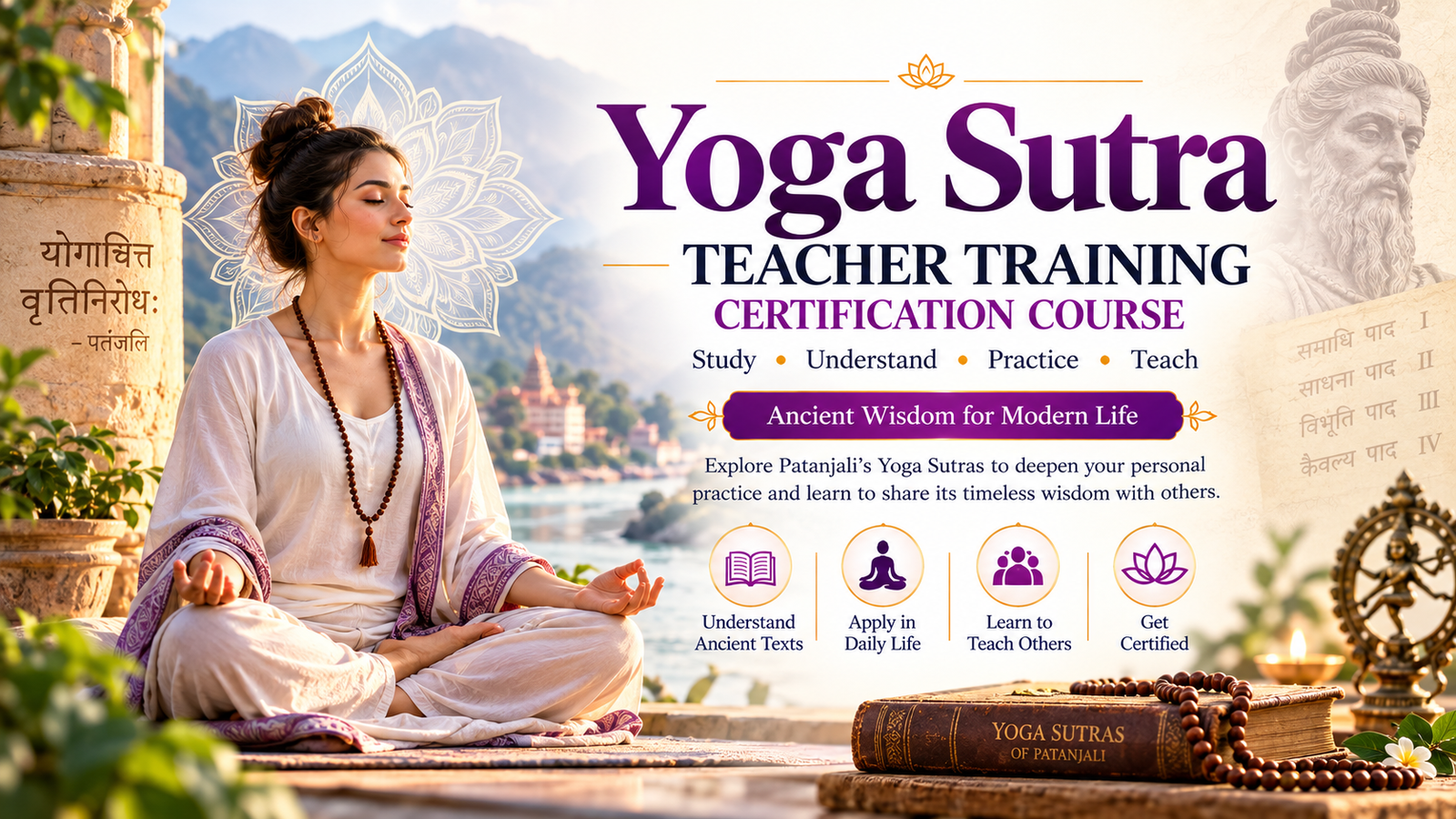
Yoga Sutra Teacher Training Certification Course

Yoga Sutra Teacher Training Certification Course (Live Online on Zoom)

yoga sutra teacher training

The Yoga Sutra Teacher Training Certification Course at Tratak Yoga is an 8-week live online programme on Zoom. It covers all four Padas of Patanjali’s Yoga Sutras across 40 classes (Monday to Friday, 8:30–9:30 PM IST). It combines textual study, philosophy, meditation practice and teaching skills, and ends with a teaching practicum, an assessment and the Yoga Sutra Teacher Training Certification.

Course at a Glance

Detail

Information

Course name

Yoga Sutra Teacher Training Certification Course

Duration

8 weeks

Live classes

40 classes of 1 hour each (40 hours of live teaching)

Schedule

Monday to Friday

Class time

8:30 PM – 9:30 PM India Time (IST)

Mode

Live online via Zoom

Text studied

All four Padas of the Yoga Sutras of Patanjali

Includes

Guided meditations, assignments, teaching practicum, final assessment

Certification

Yoga Sutra Teacher Training Certification  – YACEP

Offered by

Tratak Yoga Academy, a Yoga Alliance USA accredited yoga school

Next batch


Course fee


What Is the Yoga Sutra Teacher Training Course?

The Yoga Sutras of Patanjali are the foundational text of classical yoga philosophy. Their 196 aphorisms explain what yoga is, how the mind works, why suffering arises and how a practitioner can move step by step towards freedom, or Kaivalya.

Most teacher trainings give the Yoga Sutras a few hours. This course gives them 40 live classes.

You do not study the text as abstract theory. You follow it in Patanjali’s own order: the definition of yoga and the nature of the mind, then practice and the Eight Limbs, then Samyama and the Siddhis, and finally Viveka and Kaivalya. Every stage includes meditation or self-observation, so the teaching becomes something you have tried yourself before you explain it to others.

The course is led live. You can ask questions, discuss difficult sutras and practise teaching in real time. It is not a pre-recorded lecture series.


Who Is This Course For?

This course suits:

  • Yoga teachers (200-hour, 300-hour or 500-hour trained) who want to teach philosophy with depth and confidence
  • Meditation teachers and mindfulness facilitators who want a classical foundation for their work
  • Yoga teacher trainers who need to strengthen the philosophy module in their own programmes
  • Dedicated practitioners who want to understand what they practise on the mat and cushion
  • Wellness professionals, therapists and coaches interested in yogic psychology
  • Sincere spiritual seekers who want a structured, guided study of Patanjali

Prerequisites: No Sanskrit knowledge is needed. A regular yoga or meditation practice and an open, curious mind are enough. All Sanskrit terms are explained and practised in class.


The Four Pillars of the Course

1. Textual Study

Study the Yoga Sutras systematically across the four Padas:

  • Samadhi Pada – the nature and purpose of yoga (51 sutras)
  • Sadhana Pada – the path of practice (55 sutras)
  • Vibhuti Pada – Samyama, transformation and Siddhis (56 sutras)
  • Kaivalya Pada – liberation (34 sutras)

2. Philosophical Understanding

Build a clear working understanding of the core concepts: Chitta and Vrittis, Abhyasa and Vairagya, Ishvara and Pranava, Kleshas, Karma and Samskara, Purusha and Prakriti, Viveka, Samadhi, Samyama and Kaivalya.

3. Personal Practice

Turn the teachings into experience through meditation, contemplation, self-observation, ethical reflection and practical Sadhana.

4. Teaching Skills

Learn to explain the Yoga Sutras clearly and responsibly, and to bring them into yoga classes, meditation sessions, philosophy classes, workshops and teacher-training programmes.


What You Will Learn (Course Outcomes)

By the end of the 40 lessons you will be able to:

  • Explain the overall philosophy and structure of Patanjali’s Yoga Sutras
  • Study and teach selected sutras from all four Padas
  • Use key Sanskrit terms accurately and understand their meaning
  • Explain the Eight Limbs of Yoga within Patanjali’s own framework
  • Describe Vritti, Klesha, Karma, Samskara and Vasana, and how they form the cycle of the mind
  • Teach Abhyasa, Vairagya and Viveka as practical tools, not just definitions
  • Distinguish Dharana, Dhyana, Samadhi and Samyama
  • Discuss the traditional teaching on Siddhis with sound philosophical discernment
  • Explain Purusha, Prakriti and Kaivalya
  • Apply the teachings to your own Sadhana and self-reflection
  • Weave yoga philosophy into asana, pranayama and meditation classes
  • Plan and lead Yoga Sutra sessions and workshops
  • Explain complex ideas in clear, accessible language
  • Connect classical teachings with the needs of modern students

Yoga Sutra Course Curriculum: 40 Live Lessons

Part 1 — Samadhi Pada: The Nature and Purpose of Yoga (Lessons 1–10)

  1. Introduction to Patanjali and the Yoga Sutras. Who Patanjali was, the historical context, the meaning of “yoga”, and how to approach sutra study.
  2. Structure of the Yoga Sutras. The four Padas, how sutra literature works, Sanskrit and translation, and how single sutras connect to the whole.
  3. YS 1.1–1.4: The Definition of Yoga. Atha Yoga-anushasanam, Yogas chitta-vritti-nirodhah, and the Seer resting in its own nature. Practice: witnessing the fluctuations of the mind.
  4. YS 1.5–1.11: The Five Vrittis. Pramana, Viparyaya, Vikalpa, Nidra and Smriti, and how they shape perception. Practice: Vritti observation meditation.
  5. YS 1.12–1.16: Abhyasa and Vairagya. Sustained practice and non-attachment, the levels of Vairagya, and practice without rigid expectation. Practice: Abhyasa–Vairagya meditation.
  6. YS 1.17–1.18: Types of Samadhi. Samprajnata (with Vitarka, Vichara, Ananda, Asmita) and Asamprajnata Samadhi. Practice: concentration and absorption.
  7. YS 1.19–1.22: Faith, Practice and Intensity. Shraddha, Virya, Smriti, Samadhi and Prajna, and how the intensity of practice shapes progress.
  8. YS 1.23–1.29: Ishvara and Om. Ishvara as a special Purusha, Ishvara Pranidhana, Pranava, and japa. Practice: Om meditation.
  9. YS 1.30–1.32: Obstacles to Yoga Practice. The nine Antarayas, the accompanying disturbances, and how to keep Sadhana consistent.
  10. YS 1.33–1.51: Cultivating a Stable Mind. Maitri, Karuna, Mudita, Upeksha, breath awareness, one-pointedness and deeper Samadhi. Practice: guided stable-mind meditation.

Part 2 — Sadhana Pada: The Path of Practice (Lessons 11–20)

  1. YS 2.1–2.2: Kriya Yoga. Tapas, Svadhyaya and Ishvara Pranidhana as practical discipline for reducing afflictions.
  2. YS 2.3–2.9: The Five Kleshas. Avidya, Asmita, Raga, Dvesha and Abhinivesha in daily life. Practice: Klesha self-observation.
  3. YS 2.10–2.16: Kleshas, Karma and Suffering. Subtle and active Kleshas, Samskaras, habitual patterns, and awareness before reaction.
  4. YS 2.17–2.25: The Seer and the Seen. Drashta and Drishya, Purusha and Prakriti, identification and bondage. Practice: Drashta–Drishya meditation.
  5. YS 2.26–2.28: Viveka and Discriminative Knowledge. Viveka Khyati, the stages of higher knowledge, and moving from intellectual to lived understanding.
  6. YS 2.29–2.32: The Eight Limbs of Yoga. Yama, Niyama, Asana, Pranayama, Pratyahara, Dharana, Dhyana, Samadhi as one integrated path.
  7. YS 2.33–2.34: Pratipaksha Bhavana. Transforming disturbing thoughts through constructive attitudes. Practice: thought transformation meditation.
  8. YS 2.35–2.39: The Five Yamas. Ahimsa, Satya, Asteya, Brahmacharya, Aparigraha as living practices, not only moral rules.
  9. YS 2.40–2.45: The Five Niyamas. Shaucha, Santosha, Tapas, Svadhyaya, Ishvara Pranidhana and their psychological depth.
  10. YS 2.46–2.55: Asana, Pranayama and Pratyahara. Sthira Sukham Asanam, breath regulation and turning awareness inward. Practice: asana, breath awareness and pratyahara.

Part 3 — Vibhuti Pada: Samyama, Transformation and Siddhis (Lessons 21–30)

  1. YS 3.1–3.3: Dharana, Dhyana and Samadhi. Definitions, differences and the progression from attention to absorption.
  2. YS 3.4–3.6: Samyama. The three inner limbs working as one process, and the ethics of advanced practice.
  3. YS 3.7–3.12: The Inner Limbs and One-Pointedness. Ekagrata Parinama and continuity of awareness. Practice: one-pointed awareness meditation.
  4. YS 3.13–3.16: Transformation (Parinama). Change in characteristics, states and time, and how Samskara drives change.
  5. YS 3.17–3.22: Knowledge Through Samyama. Word, meaning and concept; reading mental tendencies; responsibility in advanced practice.
  6. YS 3.23–3.29: Extraordinary Knowledge and Siddhis. Traditional Siddhi teachings within the philosophical framework, and discernment towards extraordinary claims.
  7. YS 3.30–3.37: Further Siddhis and Yogic Powers. Symbolic and philosophical dimensions, mastery and responsibility.
  8. YS 3.38–3.43: Siddhis as Potential Distractions. Fascination versus progress, and keeping Vairagya. Practice: non-attachment meditation.
  9. YS 3.44–3.49: Subtle Knowledge and Mastery. Samyama on subtle elements, and moving beyond extraordinary experience towards discriminative knowledge.
  10. YS 3.50–3.56: Viveka, Purity and Kaivalya. Purity of Sattva, freedom from identification, and the bridge to the final Pada. Practice: Viveka meditation.

Part 4 — Kaivalya Pada: Liberation (Lessons 31–36)

  1. YS 4.1–4.6: Samadhi and Transformation. Sources of Siddhis, the refined mind and intentional practice.
  2. YS 4.7–4.11: Karma, Samskara and Vasana. How conditioning forms, continues and can be loosened.
  3. YS 4.12–4.17: Time, Objects and Perception. How the mind knows objects, and why different minds experience the same object differently.
  4. YS 4.18–4.23: Chitta and Consciousness. Mind as an object of awareness, and the distinction between Purusha and Chitta. Practice: witness consciousness meditation.
  5. YS 4.24–4.27: Mind, Discernment and Remaining Tendencies. The purpose of Chitta, remaining impressions and continued vigilance.
  6. YS 4.28–4.34: Dharma-Megha Samadhi and Kaivalya. The removal of Kleshas and Karma, and the culmination of yoga. Practice: Kaivalya contemplation.

Part 5 — Integration and Teacher Training (Lessons 37–40)

  1. The Eight Limbs: An Integrated Path. How the limbs support one another, and designing an integrated personal practice.
  2. Klesha, Vritti, Samskara and Karma: The Cycle of the Mind. How these concepts interact and how Abhyasa, Vairagya and Viveka interrupt the cycle. Practice: mind-cycle observation meditation.
  3. Abhyasa, Vairagya, Viveka and the Path to Liberation. Building a lifelong Sadhana and learning how to guide students through the philosophical path. Practice: integrated Yoga Sutra meditation.
  4. Course Review, Teaching Practicum and Assessment. Complete review of all four Padas, discussion, final teaching practicum, course assessment and personal Sadhana presentation.

How the Live Zoom Classes Work

  • Live and interactive: Every class is taught live on Zoom. You can ask questions and discuss sutras with your teacher and fellow students.
  • Consistent rhythm: Five classes a week for eight weeks builds the daily contact that serious study of a text needs.
  • Learn, practise, reflect: Each lesson moves from sutra reading to explanation, then to guided meditation or self-observation, then to reflection.
  • Teach as you learn: Short teaching presentations through the course lead to a final teaching practicum.
  • Support between classes: [Add: recordings / study material / WhatsApp or community group, whichever applies]

Class Timings in Your Time Zone

Classes run at 8:30 PM India Time (IST, UTC+5:30), which is 15:00 UTC.

Location

Approximate local time

India

8:30 PM

Nepal

8:45 PM

UAE (Dubai)

7:00 PM

Singapore / Bali / Perth

11:00 PM

United Kingdom

3:00 PM (GMT) / 4:00 PM (BST)

US East Coast

10:00 AM (EST) / 11:00 AM (EDT)

US West Coast

7:00 AM (PST) / 8:00 AM (PDT)

Times shift by one hour where daylight saving applies. Please confirm against your own time zone before enrolling.


Certification Requirements

To receive the Yoga Sutra Teacher Training Certification, participants complete:

  • Regular class attendance
  • Personal study and reflection
  • Participation in discussions
  • Assigned reading and study
  • Practice assignments
  • Short teaching presentations
  • A final teaching practicum
  • A final course assessment

On successful completion you receive the Yoga Sutra Teacher Training Certification from Tratak Yoga Academy.


Why Study the Yoga Sutras with Tratak Yoga?

  • Depth, not a crash course: 40 live lessons give each Pada the time it needs, instead of compressing the Sutras into a few classes.
  • Faithful to the text: Teaching follows Patanjali’s order and the classical framework, with Sanskrit explained and used correctly.
  • Practice-led philosophy: Every stage has a meditation or contemplative practice, so you teach what you have experienced.
  • Built for teachers: The course ends with teaching skills, a practicum and an assessment, not just theory.
  • A trusted school: Tratak Yoga Academy is a Yoga Alliance USA accredited school with campuses in Rishikesh, Pokhara and Bali, and an online school serving students worldwide.
  • Accessible from anywhere: Live on Zoom, so you can join from home.

DEEPA NEGI

Philosophy | Ayurveda | Naturopathy | Pranayama | Meditation
Rishikesh, India

Deepa Negi is a highly respected Yoga Teacher in Rishikesh, India, specializing in Meditation, Yoga Nidra, Mantra Chanting, Pranayama, Yoga Philosophy, Ayurveda, and Naturopathy. With many years of teaching experience in prestigious yoga schools, she has been a lead faculty member for 200 Hour and 300 Hour Yoga Teacher Training Courses (YTTC) in Rishikesh.

Born and raised in the spiritual city of Rishikesh, Deepa Ji carries the authentic essence of traditional yogic wisdom. Her teaching approach focuses on inner peace, self-awareness, and creating balance between mind, body, and spirit. For her, spirituality is not a concept but a lived experience — cultivating peace of mind and consistency within oneself.

In her Meditation and Yoga Nidra sessions, students experience deep relaxation, mental clarity, and emotional balance. Through Mantra Chanting and Pranayama practices, she helps practitioners understand the subtle dimensions of breath, sound, and consciousness. Her teachings also integrate Ayurvedic principles and naturopathic wisdom, guiding students toward holistic health and natural healing.

Deepa Ji believes that true spirituality can be discovered in nature. Beyond the classroom, she finds inspiration in traveling, mindful walks, and connecting with the natural world — experiences that enrich her teachings and deepen her spiritual perspective.

At Tratak Yoga, she is dedicated to guiding aspiring yoga teachers and practitioners toward authentic yogic living rooted in traditional Indian wisdom.

TRAINERS

Meet Our Certified Yoga Teacher Trainers

What Our Students Say - Reviews from Tratak Yoga Graduates

Explore some real feedback from our real Indian and international students.

EXCELLENT
4.9
Based on 89 reviews
powered by Google
  • Remarkable experience .They go extra miles to educate students

    Rajne Malhotra - International Yoga Instructor Avatar Rajne Malhotra – International Yoga Instructor

    The Calm environment and experienced teachers make’s you feel something new to learn. The Stay was great with all the amenities and with good food which builds strength to do… read more

    SandhyaSri Mahesh Avatar SandhyaSri Mahesh

    They have very calm, hygien and perfect ambience for yoga. Especially the teachers in this yoga school are specialised in their field and are concern for all students.

    Saurabh Verma Avatar Saurabh Verma
  • Hi, I am Khushboo. I went to Tratak Yoga Academy for the 50-hour Aerial Yoga course. I had a very good experience with Aerial Yoga. Especially Vishal Sir, who taught… read more

    Khushboo singh Avatar Khushboo singh

    Excellent experience

    Jyotsna Redla Avatar Jyotsna Redla

    I recently completed a face yoga course with Tratak Yoga, and I highly recommend it. The guidance and support provided throughout the entire course were truly exceptional.

    Maya Avatar Maya
  • This was a great training and was really helpful for me and was a very fun experience. I definitely recommend this training if anyone is interested.

    Shreeya Cheedhalla Avatar Shreeya Cheedhalla

    Attended face yoga online 15h training . Training is covering all aspects of face yoga , from cttm care routine , anatomy , as well deep specifics on ingredients within… read more

    Mili M Avatar Mili M

    The Face. Yoga course is excellent. The teacher mixes theory and practice very well. She explains clearly and is very patient. Jay is a great manager — he answers our… read more

    Marcela Dâmaris Avatar Marcela Dâmaris

Everything You Need to Know About the Yoga Sutra Teacher Training Certification Course

A Yoga Sutra teacher training course is a structured programme that teaches the Yoga Sutras of Patanjali in depth and trains you to explain and apply them in teaching. At Tratak Yoga it covers all four Padas over 40 live classes, with meditation practice, a teaching practicum and certification.

The course runs for 8 weeks with 40 live classes. Classes are held Monday to Friday, one hour each, which adds up to 40 hours of live teaching.

Classes run Monday to Friday from 8:30 PM to 9:30 PM India Time (IST) on Zoom. That is 15:00 UTC.

It is live. Every class is taught in real time on Zoom, so you can ask questions and take part in discussion. 

No. The course starts from the beginning with who Patanjali was and how the text is structured. Sanskrit terms are explained as you meet them. A regular yoga or meditation practice is helpful but advanced knowledge is not required.

No. The course is open to yoga teachers, meditation teachers, practitioners, wellness professionals and sincere students. Teachers gain tools for teaching philosophy, and other students gain a deeper personal practice.

You will study all four Padas (Samadhi, Sadhana, Vibhuti and Kaivalya) and the key concepts: Chitta and Vrittis, Abhyasa and Vairagya, Ishvara and Om, Kleshas, Karma and Samskara, the Eight Limbs, Samyama, Siddhis, Viveka, Purusha and Prakriti, and Kaivalya. You will also learn to teach them.

The four Padas (chapters) are Samadhi Pada (51 sutras on the nature of yoga), Sadhana Pada (55 sutras on the path of practice), Vibhuti Pada (56 sutras on Samyama and Siddhis) and Kaivalya Pada (34 sutras on liberation). Together they form 196 sutras.

The Eight Limbs, or Ashtanga, are Yama, Niyama, Asana, Pranayama, Pratyahara, Dharana, Dhyana and Samadhi. Patanjali presents them in Sadhana Pada as an integrated path. This course studies them in the Sutras and revisits them in the integration lessons.

On successful completion you receive the Yoga Sutra Teacher Training Certification from Tratak Yoga Academy. Requirements include attendance, assignments, teaching presentations, a final practicum and an assessment.

Yes, after complete this certification course, you will be eligible to add this course at continuing education program as philosophy module on yoga alliance. 

Yes. The course is fully online and open worldwide. Please check the class time in your time zone using the table above.

Ready to Study Patanjali’s Yoga Sutras in Depth?

Join the next live batch and move through the Yoga Sutras from Atha Yoga-anushasanam (“Now, the teaching of yoga”) to Kaivalya, with guidance, practice and certification.